Some dates come back every year and it brings back a flood of memories. One such day was 27 July 2011, the day I left Rome to return to Canada. W and the puppies had left 10 days prior and I was alone at the apartment, it was empty all our belongings had been packed up and shipped to Canada by boat, I had a so called pack-up kit, which meant I was camping at home. But I simply went out a lot to enjoy my last days in the Eternal City.
On the morning of the 27 July I was all packed and when the driver arrived, I took the suitcases and walked out, only after I closed the door behind me, did I suddenly realize that was it. We were not really ready to return to Canada, I had been away for many years at that point and did not see what there was to return to frankly. It has to be said that when you live in a foreign country or on various continents for many decades coming ''home'' is meaningless. Where is ''home''? Rome was home to us, I could not imagine another home. We had a home in Warsaw, in Cairo, in Mexico and Chicago.
Reesie died in Rome and that is where he is buried. We had wonderful friends and a busy social life. In returning to Ottawa we had to re-invent it all and with some difficulties. It has been two years now and we have kept a strong bond with Italy and Rome. I can understand that for someone who has not lived abroad, it may be difficult to understand. We did not take the trip of a lifetime, our life was one long and enjoyable adventure around the world. So often when I hear someone say something or a piece of music or taste a dish or some wine, it brings back memories. Per example I can never listen to Madama Butterfly without thinking of the Summer Opera Season at the Terme di Caracalla in Rome and that evening when in the open air we saw this giant moon rise over the ruins and the Roman Pines as the music of the first Act was playing. http://www.operaroma.it/eng
However upon my return to Canada I was seriously thinking of retiring, so Rome was our last post.
Not that I regret retiring, on the contrary. We continue to travel but it will never be quite the same as living in a foreign country and having a life style which suited us fine.
Here are some photos of our street and neighbourhood.
 Our street Via dei Villini
 the driveway at number 26.
 a corner of the living room
 part of the view from our balcony terrace, at each sunset we would be entertained by small dancing bats as we finished dinner and then the owl would make his usual hoot hoot noises.
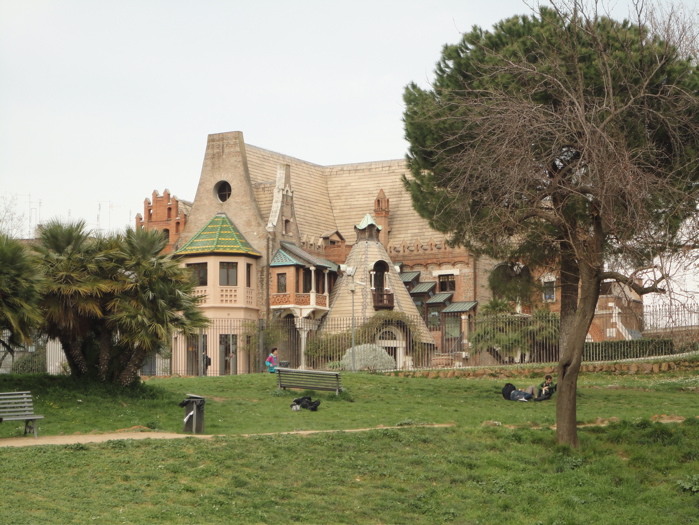
 At the end of the street were the massive Aurelian Walls, built by Emperor Marcus Aurelius. We were outside the walls. Outside the walls of Rome until 1910 meant the countryside, after 1920 suddenly the city expands and with the arrival of Mussolini to power in 1923 entire new neighbourhood spring up in what was once considered countryside. The grand homes of our neighbourhood where built around 1880 and 1900 and all considered to be villas in the countryside. Some of these villas were small palaces and built by the Italian Nobility and well to do families with great gardens often the size of a city park, like at Villa Torlonia now a public park. Today many have been converted into offices or apartments. The gardens where sold separately to make way for more buildings. They are still grand in architecture and design, memories of a bygone era. We loved to walk the dogs looking at these places. It is an easy city to walk in, everywhere there is something to look at, a view, often designed as if a theatre set.
 former villa converted into the office of the Actors Guild on Via di Villa Patrizi
 Beautiful fresco on a former villa now a condo building on Via Savoia
 modernist style building now a condominium Via di Villa Albani
 Some like this villa has a roaring lion perched on its roof.
 I always like this little villa with its pompeian red walls and wysteria growing on the facade.
Those neighbourhood streets were quiet and it was nice to simply walk along them. There was always something to observe and the changing light of day made it more beautiful.
 Side entrance to the Italian Presidential Palace, formerly the Royal Palace on Via del Quirinale. The inscription above the door mentions that 3 Popes built this palace as a then Papal summer residence on the ruins of the great Temple to Isis, Innocent XIII , Alexandre VII and Clement XII. The Carabinieri police guard is wearing is ordinary summer uniform. At the back a Corazzieri Guard.
 Corazzieri in gala uniform on the terrace of the Quirinale Palace. You would see them at functions.
Certainly elegant, dignified and stylish.
 Porta Pia taken so many times to enter into the City down Via XX Settembre. Today this ancient gate of Rome is at the centre of the City. Nero took this gate when he fled Rome with his Pretorian guards in hot pursuit. Garibaldi entered Rome with the Bersaglieri Regiment liberating the City from the Popes.
 Not in our neighbourhood since it was at the other end of town across the Tiber. Could not resist, the Vatican Academy of Sciences, this building is a copy of Nero's palace built 500 years ago by St-Charles Boromeo as a pleasure palace for parties etc... He was the wild nephew of the Pope. Located inside Vatican grounds and not open to the public. The mosaic are made of coloured sea shells by the thousands, imagine the picking on the beach and sorting out afterwards. We had a special private visit of the Academy, what an incredible place for a party.
All in all nice architecture, lots of style, elegance and beautiful memories.
On the morning of the 27 July I was all packed and when the driver arrived, I took the suitcases and walked out, only after I closed the door behind me, did I suddenly realize that was it. We were not really ready to return to Canada, I had been away for many years at that point and did not see what there was to return to frankly. It has to be said that when you live in a foreign country or on various continents for many decades coming ''home'' is meaningless. Where is ''home''? Rome was home to us, I could not imagine another home. We had a home in Warsaw, in Cairo, in Mexico and Chicago.
Reesie died in Rome and that is where he is buried. We had wonderful friends and a busy social life. In returning to Ottawa we had to re-invent it all and with some difficulties. It has been two years now and we have kept a strong bond with Italy and Rome. I can understand that for someone who has not lived abroad, it may be difficult to understand. We did not take the trip of a lifetime, our life was one long and enjoyable adventure around the world. So often when I hear someone say something or a piece of music or taste a dish or some wine, it brings back memories. Per example I can never listen to Madama Butterfly without thinking of the Summer Opera Season at the Terme di Caracalla in Rome and that evening when in the open air we saw this giant moon rise over the ruins and the Roman Pines as the music of the first Act was playing. http://www.operaroma.it/eng
However upon my return to Canada I was seriously thinking of retiring, so Rome was our last post.
Not that I regret retiring, on the contrary. We continue to travel but it will never be quite the same as living in a foreign country and having a life style which suited us fine.
Here are some photos of our street and neighbourhood.


Those neighbourhood streets were quiet and it was nice to simply walk along them. There was always something to observe and the changing light of day made it more beautiful.


Certainly elegant, dignified and stylish.


All in all nice architecture, lots of style, elegance and beautiful memories.