Friday, 8 August 2014

Ferragosto Season.

We arrived in late July in Rome in 2007 with a mountain of luggage I kid you not, we probably had 5 suitcases each plus a large dog kennel for our Reesie who in his old age and deaf had accompanied us to Rome. Arriving on the eve of the great vacation month of August has its challenges for North Americans who are not used to seeing an entire country come to a standstill because everyone is gone to the beach or the mountain.

Fiumicino airport, one of the departure-arrival pods. 


We were met at the airport by my colleague and a small van and an embassy driver. It was afternoon around 4pm and we drove from the seaside where the Rome Airport Fiumicino is located to la Città some 35 Km away. It is very green on the way into the city and there are lots of Mediterranean Pines those famous umbrella pines which gives Rome that special look. The driver took us along the highway and then just after the suburb of EUR we came into the city proper down the great avenue San Gregorio Magno to the Arch of Constantine and the Palatine Hill, around the Colosseum and then up the hill towards the Aurelian Walls. We were in awe, Rome looked majestic as it should. There was also surprisingly little traffic and the city had already assumed that look of summer holiday.

The Column of Trajan 

The Palatine Hill amongst the Pines

Via San Gregorio Magno, on the left the Arch of Constantine and on the right the Colosseum.

When we got home to our new digs which was down Via Nomentana outside the walls at Via Asmara the neighbourhood had the look of being deserted, everything was tranquil, all the stores where shuttered. My colleague explained that with Fer'Agosto approaching the only stores open would be on reduced hours and the rest would remain close, so if we wanted anything it would have to wait until September 7 when school starts again and everyone gradually returns to the City. It is the same tradition everywhere else in Italy.

Just 10 years prior another colleague who had been on posting in Rome explained how during this period if you wanted fresh milk and eggs or bread you had to make arrangements with farmers around Rome who supplied clients in the City. The philosophy of all this was that everyone deserves a vacation and why not in August, the only problem is that everyone in Italy is on vacation at the same time. Meaning crowded highways, beaches and country resorts, many also visit the family in the Paese (village) where they come from.

So our first summer in Rome was spent exploring a neighbourhood which was deserted and quiet. There was one restaurant opened near us I Limoncini on Via Del Giuba and it was pleasant to have dinner in the evening.
We started to discover Roman and Italian cuisine specialty, much of it being seafood, veal chop, young lamb chops and various pasta dishes unknown to us. Limoncini's specialty was spaghetti with a delicate lemon sauce. With time we became friendly with the owner, his wife and son Cristiano.

The shopping streets around us like Via Libia or Via Tripoli or Via Eritrea all the shops were closed, what a sad sight but when life came back in early September we were even more surprised to see so many shops. You can tell by the name of the streets that this neighbourhood was build between 1925 and 1936 during the prosperous years of the Fascist Era, the streets bear the names of the colonies of Italy in that period. The architecture is in the brutal modern style re-calling the Antique Roman style.

I would go to work, walking down Via Nomentana to Via Zara where my office was a good 15 minute walk but always pleasant, the streets are lined with tall old trees forming a green canopy. Since this street as always been outside the walls of the city it was lined with great suburban villas and parks, once owned by the wealthy families of Rome. Today many have been converted to other uses but the parks surrounding them are just as beautiful as always.
I passed a park in Villa Paganini and noticed that the grass was growing tall, indeed even city municipal services were cut back. It would be tended to in September when the city workers would come back.

This was 2007 by 2008 things had changed, the holiday period started around the 5 August instead of a week earlier. The economic situation in Italy was not good and people cut their vacation short.
Then in 2009 the date was pushed back to 10 August and the rumour was that many did not leave the city at all but hid in their apartment, the shame of having to admit to your neighbours that you could not afford to leave the city for 3 week vacation with the family. I am told that this year only those who can really afford a vacation leave the rest will take 8 days which is the period between 10 to the 18 August. Fewer shops close, many do not close at all but operate on reduced hours.
The economic situation is such that life has become difficult for the majority.

During our period in Italy, we travelled to the Adriatic to the province of Le Marche, to the birthplace of Rossini, the beach resort of Pesaro where each year at the time of Fer'Agosto there is a Festival dedicated to his operas.  It is along the lines of what you see in Salzburg but on a reduce scale but nonetheless of the highest quality, we are in Italy and Italians do not joke with opera, it's serious business.
The web site: http://www.rossinioperafestival.it


Pesaro is a easy drive from Rome on the highway A24 then E55 in 3:30 hrs. We would usually stop in Ancona for lunch and then complete the road trip passing Fano on the way following the coast line of the Adriatic.
As the years went by with the economic crisis, it was much easier to find hotel rooms for the week.
Pesaro is a small town, it was once at the time of Rossini part of the Grand Duchy of Urbino and then a Papal State. Rossini left early in his career he could not stand the suffocating atmosphere of being under the Papal thumb. He spent most of his long life in Paris becoming fabulously wealthy in the process.


My favourite house in Pesaro, pure Art Nouveau on Piazza della Vittoria.

Pesaro being a resort town its business as usual and you will find many expensive designer stores, there is obviously a lot of money in Pesaro. Like Rimini just a few minutes north it attracts many wealthy Europeans and the beautiful Art Deco Villas are rented or sold to catered to that crowd.
Strangely in winter the city is deserted and most hotels and businesses are closed. Those who do remain open offer room rates of 40 Euros a day while in the summer it would be around 120 Euros and up which usually includes breakfast and sometimes half board. There was one Hotel owner who had a monopoly on 5 hotels in town. We stayed in two of his hotels, they were typical Italian hotels, by this I mean they were decorated with the owner's own personal touch. One was the Alexander Museum Palace Hotel, art work everywhere even in the rooms and bathrooms, all very modern. It is not to everyone's taste.

The web site: http://www.alexandermuseum.it
The owner is an eccentric Italian aristocrat Count Alessandro Marcucci Pinoli di Valfesina or Nani for his friends, formerly an Italian Ambassador to Bolivia and now Honorary Consul of San Marino. He is pictured half submerged in a suit and tie in the endless pool, an eccentric marketing ploy which works well in Italy but would not work so well with North Americans who might think he was daft.

He owns other hotels like the Savoy http://www.hotelsavoypesaro.it/en and the
Hotel Gran Vittoria http://www.grandhotelvittoriapesaro.it we enjoyed this hotel for its old charm and central location.
Evening on Piazza del Popolo in Pesaro

One of our favourite bars in Pesaro for il aperitivo.


How much we enjoyed those summer holidays in Pesaro.
This year no Pesaro but Stratford Ontario, with friends, it will be just as much fun.

Here is a clip from one of my favourite movie about Ferragosto.

Buon Ferragosto a Tutti!


Monday, 4 August 2014

Holiday Monday walk

From my front door I can go either North or South and walk in a park at all times. The Rideau Canal which 214 Km long, provides in the heart of the City this great green park. It was built in 1832 and cost a fortune, it was to be used for military purposes but never was.

I went South today towards the renovated Lansdowne Park. A quiet leafy residential area of great houses which is part of the Glebe neighbourhood. The area is so quiet that you think that you are in the countryside and forget that you are in the middle of a City of 1 million people.


 Canadian Winter Olympic Monument at Lansdowne Park


This funny little island in the middle of the Canal is a protected area and I do not know why, it is simply a tuft of green surrounded by water. The other side of the Canal is called Old Ottawa South, it was the southern limit of the city until 1960. There was only fields beyond that point, the area is like a finger between the Rideau River and the Rideau Canal, with lots of very nice houses built in the 1940's and 1950's.


The National Capital Commission is responsible to keep the area clean and plants the numerous flower beds. The flower beds are planted with tulips in April and then in June with more Summer flowers.

This small inlet was once part of the canal and now stands cut from it by a road. When the canal was built this inlet was a staging area for the engineers and workers.
 We are just North of Dow's Lake a former large swamp flooded by the Corps of Royal Engineers to make a lake below Hog's Back Falls. 


View from our apartment looking North towards the Campus of University of Ottawa.

 This area is still not finished the barricades will be removed and it is to become a skating rink in winter and a water plaza in summer. The lowest building in this photo in red brick is the renovated Horticultural building which was moved on rails from Bank street to the East Side of the park a distance of about 350 meters. The modern buildings are part of the shopping complex and the tower at the back is a new condo building, unfortunately a lot of this architecture is in a brutalist modern style.


The old Aberdeen Cattle Palace, c.1898 at Landsdowne Park, originally the park was on the outskirts of the City and was used as a horse race track and for agricultural fairs annually. Farmers from the Valley would come to Ottawa to exhibit all manner of farm products and animals. The Governor General would give out prizes. Later a Football Stadium was built, it was demolished 2 years ago and a new stadium built for football and for soccer. The Aberdeen Cattle Palace is now used for all kinds of events. The large green space in front is new, it was a parking lot until very recently. There is now only a very small parking lot underground for permit holders only. If you wish to come to the Stadium for a game you can walk or take the free shuttle buses. It is not possible to park your car anywhere. The New Lansdowne Park opens 16 August and the shopping retail area will open in November. I still want to visit the grounds once it is open to the public to have a good look around.


Sunday, 3 August 2014

Our failure as a Society witnessed

We do live in a Society which promotes individual worth and values at the expense of the Community as a whole. When we say our Community or Community values it is a very vague concept and one which does not or must not interfere with personal individual rights and values. In fact the word community nowadays in modern Canadian Society is pretty meaningless, the same goes for Community Leaders this is a term the media loves to use when it is trying to support the idea that an initiative or a project has a wide support amongst people. That is not true, the majority are too busy pursuing personal goals to bother much with the so called community.

In Canada today there are 3 types of what could be defined loosely as a community, there is the Rural group mostly farmers and individuals who live outside cities.

Then there are suburbanites, people who live in these large bedroom communities with malls and is composed mostly of either Heterosexual White Christian groups or large single Ethnicity groups who live in a suburban ghetto, they can be Asians like in the Suburb South of Montreal or in Suburb around Toronto which use to be small towns now absorbed in larger metropolitan areas. This group usually sees the inner city as dangerous and full of crimes, despite the fact that the crime rate in Canada is as low as in 1970.

Finally you have the City Core dwellers who are either old or young, rich, middle class and the urban poor, the Natives, the disabled, comprising every ethnic background in very varied neighbourhoods. Many have always lived in the City itself and are usually more progressive socially.

So in other words the idea of a community does not really exist in a Society dominated by the pursuit of individuality, social responsibility is diluted and this may explain, only in part, why we have so much indifference towards the many poor people old and young in Canada. There is also in the last 25 years the rapidly changing economy and in Canada we are clearly creating more minimum wage jobs in the service industry and inequality in general is on a rapid rise. One million Canadians do not have enough to eat or go without food on any given day, that is what is called food insecurity, 14% of children in Canada are poor and suffer from lack of adequate food, this is the highest rate in all industrial nations. Some 40% of Canadians pay two thirds of their income in rent or mortgage, housing in Canada is expensive.  All this to say that Canada is on the fast track to economic disparity and poverty for the majority.

The economy may be rock solid for some, like the Banks and the Oil Company an image our PM Harper spins endlessly, but for your average Canadian it is very far from being rock solid, more choppy seas with much uncertainty and with record personal debt. You loose your job and all of a sudden you are tipped into poverty.

Yes the urban poor is nothing new and existed since we have had cities in Canada, it has been a difficult problem to effectively deal with. Most people prefer to think that it exist but is not that serious and could be remedied easily with a bunch of social measures. Or worse that people who are poor deserve it because they are lazy. It is also easy to look down on the poor because they fit into a category we do not understand and do not want to know about.

All this to say that like most people I had heard of poverty in our cities but in the last 16 months I have become more aware of it. First was a conversation I had with the Director of the Soupe Populaire in Gatineau, his soup kitchen feeds the urban poor in the city across the river from the National Capital, he told me that in the winter of 2013, some 12 people had frozen to death on city streets in Gatineau. In Ottawa the Nation's Capital the numbers are a little higher, unbelievable when you think that most Canadians love to tell the world how rich we are. It is a National disgrace that this should happen, we do have enough shelter beds in the City provided by Churches and other groups but some people because of mental health issues do not want to participate and fall in the cracks. The other national disgrace is the situation of the Native people in Canada, there are about 1 million natives all around Canada. Recently I was speaking with UN Officials and I was told how completely horrendous the situation of Natives has become, the effect of years of neglect by the Federal Government on top of the savage budget cuts of the Harper government and the incredible level of violence suffered by native communities is beyond what we imagine Canada to be about. As a country we are failing at several social policy levels and also in terms of responsibilities towards our Native population. But most Canadians are totally oblivious and simply do not want to hear about it, which suits Harper and Co. fine. At any rate the UN is not much liked by the current government and this has been made clear in Official speeches.

I started to volunteer at the Shepherd of Good Hope on Murray Street in Lower Town, it is the largest shelter in the Capital, very well established it provides many services to the homeless and disadvantage including those suffering from mental illness though on that level what they can do is limited.  So I go and serve lunch, the routine is fairly simple, we get there by 08:30am and you are given food preparation duties, you may be asked to peel potatoes, cut up meat, make sandwiches, etc..

This past weekend I made about 150 sandwiches in about 2:30 hours, these sandwiches are given to anyone who comes after lunch looking for food. At 11:30am lunch service starts, all the food served is fresh, the menu changes daily and the food is good and wholesome, there is always a hot dish, a stew or a pasta, a soup, salad, bread and butter, dessert and coffee or tea. There are also vegetarian meals for those who want them.

The manager asked me to go to the door to greet the lunch crowd. Some 260 men and women came in, all young or old, many were faces I recognised, you see them in the market or around town. This was a slow day, being August, a long weekend and welfare cheques had just been given out. On a busy day some 400 to 500 persons will come in. One fellow asked me if there was any food left, he said he was really hungry he had not eaten in a day or so.  I could see the pain on his face, the stress and the fear that he might have missed lunch. It is very hard to think that anyone would be in that position, shocking in fact.

The Shepherd of Good Hope buildings is in a central location in the Capital surrounded by expensive condo towers and affluence in the nearby Rideau Centre, expensive shops and National Museums. This is not an isolated part on the edge of town.

What is amazing is how polite they all are, many are very courteous, quick on the thank you and speaking softly, no one that I have seen was loud or aggressive though I can imagine this happens.  I did have one fellow who came in and said to me rather sharply that he had heard we had chili with meat again, is that all you folks can prepare he asked. I told him simply what the menu was today, he looked at me surprised and said oh well that is nice and lined up at the counter.

Some people wore the marks of a recent fights, two women had big shiners, a man had his nose freshly broken and someone had taken a knife to his face. Another women maybe she was in her forties, hard to say, had a leg that had been broken and had not healed properly so she had a pronounced limp. Many Natives in the group and Innu, they are a special case because they come from the Arctic circle and here down South they are completely out of their element, it is very sad to see. Some are manic and this is out of character given their culture but obviously under a lot of stress.

So I stand by the door and say hello to those who come in, they will ask me about the menu of the day, all insist on washing their hands, and then line up at the cafeteria with their trays, they can eat as much as they want. Eating is such a human thing, no food and you die, washing one's hand, the need to feel clean is very important also. Simple courtesies, a simple hello, a word of welcome, a smile, it makes anyone feel more human, part of society. It is so simple, but it is what we all expect without often realizing it.

I also tell them, though they know the routine, that we have sandwiches also for the afternoon. Some will ask about water for their dogs, though we do not give them food for their pets. When you see such numbers coming in for a meal, it gives you an idea of the magnitude of the problem. I also work at the slop table which is clean up after the meal, cleaning plates and trays. All the dish ware is heavy duty porcelain, same with cups.

I do not know if I could do this volunteering on a regular basis, it is psychologically hard. Your first reaction is to feel embarrassed to see this kind of poverty. We do live in a world where most people feel they are paying too many taxes and the government is too intrusive, so you hear or read the heart less comments, few want more social programs, not understanding that organizations like Shepherd of Good Hope keeps the lid on social peace and is our safety net. I know first hand the misery of poverty in the Third World where there is little or no social programs or Caritative organizations like Shepherd.  There is an urgent need to get off the mean and corrosive thinking wagon we have embarked on in the last 9 years.  I can only hope that the support Shepherd is getting in Ottawa will continue and be strengthen, their role is valuable in providing a respectful and stable place for those who have been pushed to the wall.


Saturday, 2 August 2014

Happy from Canada

The song Happy from Ottawa, Montreal, Toronto. Very well done.

Thursday, 31 July 2014

The Centennial of the Great War, August 1914-2014

Today on 1 August 1914 the Great War started for Canada, we entered the war on the side of Britain and the Empire. Canada sent 10% of its population to war, some 620,000 men, poorly equipped and trained. At the end of the war some 61,000 Canadian soldier will be dead and another 18,000 will be missing never to be found buried in the mud of the Western Front.

Rightly so the Canadian people would ask ''For What ?'' a question the Conservative government of Sir Robert Borden had no answer.

Look at this map of Europe in August 1918 and note how the old Continent looked then. Four great Empires would collapse, Germany, the Austro-Hungarian, Russian and Ottoman Turk. Britain despite the armistice in November 1918 very nearly collapsed. This war would change the world and Canada.


In 1919 Europe would see new countries emerge which did not exist previously, created from nationalistic grievances. The Paris Conference would create many new problems and the final Treaty of Versailles will plant the seeds for a new war even more devastating some 20 years later.


Canada would emerge as a great power and would become an independent country, leading to renewed prosperity until the great economic depression of 1929.
Who knew that August one hundred years ago what was about to happen to the old order.

Europe today looks again very different since 1989 and the fall of the Iron Curtain and Communism.


The ceramic poppies planted around the Tower of London and on show now until November.
Some 888,000 poppies represent the sea of blood this war provoked, no one won, ending in an armistice, a war that cause much misery and no resolution.


Three Summers ago

We have now been living in Ottawa for 3 years, we lived here off and on since 1976, but with my postings there were long periods when I was away from the City.

Our return after many years abroad was not easy on many levels. Strange to say but there was culture shock when we returned and also a long period of adaptation. It is difficult to explain to anyone who has not lived abroad, physically out of Canada. Re-entering Canadian life can be very difficult, you forget so many things about life here, the attitudes, culture and the tempo of life in general. We had to re-learn a lot of things, life in Canadian Society has its peculiarities.

Going from a small office where you have real responsibilities to a giant one at HQ where you have no responsibilities and dozens of managers who are more of less incompetent is an adjustment. The first year back at HQ was difficult, nothing made sense and it felt like working with a bunch of chickens running around whose head had been cut off. More uncertainty, more lies and more hypocrisy about where we were going as a Government. Our Minister Jason Kenny could not bring himself to saying Good Morning to people, it was beyond his capacity, this is how much he loathe his own employees. Senior Management were shitting their pants so afraid they were for their jobs and all hoping they could retire before things got too ugly or out of hand. I certainly did not recognize HQ after a 7 year absence, too much had changed for the worst unfortunately. To many 20 something running around pretending they knew it all and had seen it all, they had a University diploma don't you know. To many experienced hands retiring or being pushed out because they were over 55. What is the point of staying anywhere if you are no longer wanted. Better to leave and forget the rest, and this is what I did, I can honestly say now that I have no contact with my former employer and frankly I do not miss any part of it.

We were lucky that we found a very nice apartment immediately, with good neighbours and were able to settle well in a pleasant surrounding. We also had our friends in Ottawa, they must have found us a little strange with our comparisons. We had to reason with ourselves and admit that there was no comparisons to be made and just stop looking at things in an odd fashion as if we could wake up from a bad dream. It is at this time that I started to remember old colleagues who had spent 20 or more years living abroad and never returning to Ottawa. When they finally returned near the end of their careers many simply could not live in Ottawa the cultural shock was too great.

Even today many colleagues retire elsewhere in Canada or abroad. We chose to retire to Ottawa for the time being.


I had the good fortune of having the presence of mind to start thinking about two years ago before my retirement of what I wanted to do once retired. I do not think I could have simply stayed at home and do a little reading and walk the dogs. Luckily I fell into a very good opportunity and it has worked out very well for me at the museums.

I also made a trip back to Rome in March of 2012 and this was a very good trip and was enormously helpful in focusing what I wanted to do with the rest of my life. It has not always been easy to go forward in the last three years but now I feel that we are settling in Ottawa and I have lots of interests in what is going on in the City and in the volunteer activities I am involved with.

Rome and Italy will always be with us and as we discovered anytime we go back and we have returned many times, it is like home. We are building a new life here and a more permanent one.
Renewing our lease for another 2 years also adds permanence and this is helpful to give us a feeling of belonging.


This painting by Giovanni Paolo Pannini of an art dealer's emporium in many ways reminds me of what I am now doing as a docent and how much I enjoy it and all the other activities connected to it.


Wednesday, 30 July 2014

Some photos around Ottawa

In 2017 Canada will celebrate it's 150 Anniversary as a unified country, this is when the 4 original Provinces ( Quebec, Ontario, Nova Scotia and New Brunswick) united to create the Federal Government in Ottawa.

So you can imagine everything that can be re-built, renovated, improved is being done right now and will be until 2018. The City Ottawa is under an impossible to drive around program of re-building the sewer system on all major roads, re-surfacing is taking place also, a new light train system is being built. Then major improvements and new buildings are springing up everywhere. The Queensway highway 417 which crosses the city from East to West is also being enlarged with new overpass and more lanes.  In the centre of the City the Parliament precinct is completely being re-built at a cost of well over 3.5 Billion dollars, politicians want the best for themselves but not for you. There are barricades everywhere, not to mention new monuments to pet projects of our controversial and infamous Prime Minister Stephen Harper, hopefully he will be gone next year and polls indicate that there will be a totally new administration in town in 2015.

So in other words skip Ottawa until 2017 when most of this construction will be over with. Ottawa is worth visiting when there is no construction. However in the summer what is very nice around the city is the display of flowers.

One of the original Trafalgar Square (London) fountain from 1843 given to the National Gallery of Canada in 1955 and installed in Confederation Park in 1975.

 Flowers on Elgin street in front of the National Arts Centre


Flowers on Sparks Street 

Sparks Street is the oldest pedestrian mall in Canada. Unfortunately deserted after 5pm and on weekends. It is an office tower area with very few shops and a lot of construction right now in the Parliament Precinct area. 


Queen Street, the Light Train tunnel is 30 meters underneath but the real story here is the old Cemetery and the hundred or so graves discovered in this trench. About 110 years ago the cemetery was moved from this area but those who could not afford to move their dead relatives or the dead who had no one to claim them were simply paved over. Now the City has moved everyone out and is looking for relatives who might want to claim those unfortunates. This is going to be very difficult to see the least. They probably will simply end up in a communal grave in one of the Cemeteries in the City.


The West Block of Parliament under wraps, no it is not an art installation by Christo et Jeanne-Claude. No it is part of the massive renovation project of $3.5 Billion dollars so far to modernize these buildings built around 1860. This is only phase one, once this project is completed in 2017 the central block will be closed and renovated. Both the House of Commons and the Senate will move out. The House will sit in the Courtyard of the West Block in a exact replica of the House and the Senate will sit in the old Train Station for a period of a few years. The whole project is to be completed by 2027. The final cost is a closely guarded secret.

 The Bank of Montreal branch on Sparks street at O'Connor across the street from Parliament
is to become the new Party Central for Parliament. This spectacular building in pure Art Deco was built in 1930, it is all black and white marble inside and the floor also in marble is made to look like waves from sea to shining sea. It is now under renovation some $210 million dollars has been spent modifying the building, I do hope they have not ruined it in the process. Mind you the public will never know since once it is completed it will be off limits to mere mortals.

Details of the wrought iron in the windows re-silvered and re-gilded.

Sparks Street in Ottawa has been transformed in the last 50 years from a vibrant pedestrian mall with shops to a dead zone. Once the Parliamentary precinct work is completed it will become part of Official Ottawa and off limits to citizens, occupied mostly by Parliamentarians and their staff when they are in town Monday to Thursday.

However another chain is opening for beer drinkers, Ottawa is a beer town it is simply a question of dollars and cents, you can buy a lot more beer than wine.

In the old abandoned Woolworth's and Zeller's store Bier Markt is opening a giant restaurant and beer garden. You have to wonder how they will succeed given that they depend on the lunch crowd. No one around after 5PM and no one on weekends.

Another heritage building circa 1890, the old Yesterday's which use to be Sherry's restaurant, the food was rather pedestrian to go with the mall, it finally closed. It is being renovated and Dunn's smoke meat house is opening to go with the Beer hall across the street.

Grant House on Elgin Street, for years this old patrician house built in 1873 was a famous roast beef restaurant, then it closed. The house sat empty for a few years and now it has been restored and Chef Beckta is opening a million dollar restaurant and wine cellar which given his reputation would be a premier restaurant in the Capital. The house has been incorporated into the new Canada Council building.

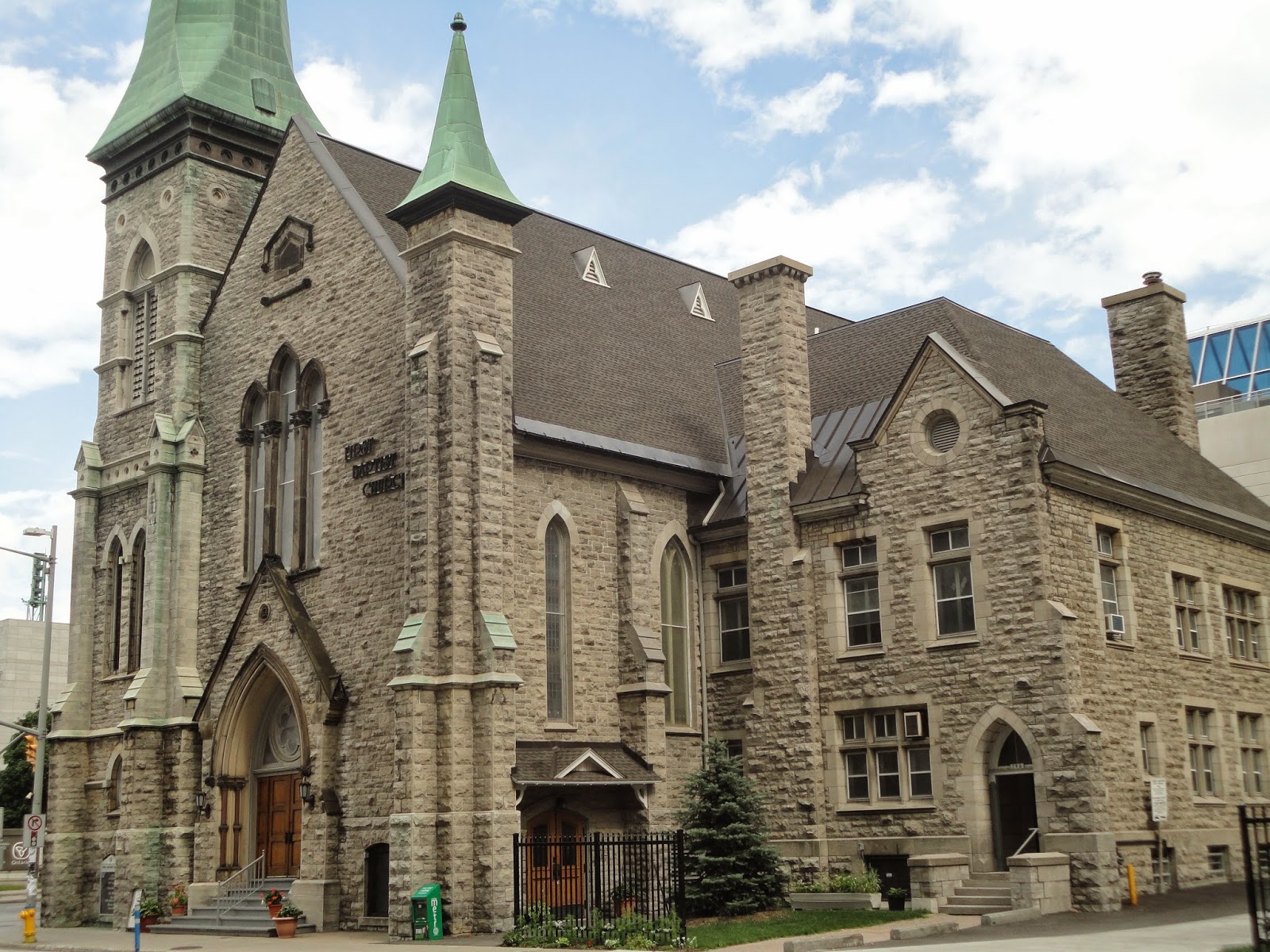
Next to Grant House is the First Baptist Church c. 1875.

The Old Teacher's College on Elgin street, c.1870 now the Office of the Mayor of Ottawa.