Showing posts with label Europe. Show all posts

Thursday, 31 July 2014

The Centennial of the Great War, August 1914-2014

Today on 1 August 1914 the Great War started for Canada, we entered the war on the side of Britain and the Empire. Canada sent 10% of its population to war, some 620,000 men, poorly equipped and trained. At the end of the war some 61,000 Canadian soldier will be dead and another 18,000 will be missing never to be found buried in the mud of the Western Front.

Rightly so the Canadian people would ask ''For What ?'' a question the Conservative government of Sir Robert Borden had no answer.

Look at this map of Europe in August 1918 and note how the old Continent looked then. Four great Empires would collapse, Germany, the Austro-Hungarian, Russian and Ottoman Turk. Britain despite the armistice in November 1918 very nearly collapsed. This war would change the world and Canada.


In 1919 Europe would see new countries emerge which did not exist previously, created from nationalistic grievances. The Paris Conference would create many new problems and the final Treaty of Versailles will plant the seeds for a new war even more devastating some 20 years later.


Canada would emerge as a great power and would become an independent country, leading to renewed prosperity until the great economic depression of 1929.
Who knew that August one hundred years ago what was about to happen to the old order.

Europe today looks again very different since 1989 and the fall of the Iron Curtain and Communism.


The ceramic poppies planted around the Tower of London and on show now until November.
Some 888,000 poppies represent the sea of blood this war provoked, no one won, ending in an armistice, a war that cause much misery and no resolution.


Tuesday, 17 June 2014

de retour

We are back from our pilgrimage to Salzburg Pfingstfestspiele via Munich and then on by train to Dresden and by boat on the Elbe River to Meissen. Beautiful weather all along and maybe a bit hot at 30 C, but I am not complaining after the dreadful and very long winter (4 mo. and 7 days) in Ottawa.

We arrived in Frankfurt and took the train from the train station in the basement of the airport to Munich, you have to give it to the Germans as masters of organization in terms of public transport something we do not seem to understand in Canada.

When in Munich we stay at the Eden Hotel Wolff on Arnulf Strasse 4, immediately across the street from the Haupt Bahnhof, very central and in walking distance of all the sights.

In Munich at the Kunsthalle I went to see the Otto Dix and Max Beckmann painting exhibit World as Myth covering the period of the Weimar Republic 1919-1930. They are both the most important German artists of the first half of the XXth century.  As of 1933 they will be blacklisted by the Nazis as Degenerate non-German artists. This exhibit in Munich has 180 works on display, paintings, drawings and prints from many important museums and private collections. See the website http://www.kunsthalle-muc.de


This year being the Centennial of the beginning of the First World War also known as the Great War 1914-1918, many exhibits around the world are devoted to painters like Otto Dix. At the Canadian War Museum in Ottawa currently on display is an exhibit entitled ''Transformations'' which features his work and that of A.Y.Jackson who was one of the painters of the Canadian War Memorial Fund of Lord Beaverbrook.  Saturday 28 June will be the 100th anniversary of the assassination in Sarajevo of Archduke Ferdinand and his wife Sophie, the trigger that will provoke an unfortunate series of events leading to the start of the Great War on August 1, 1914.

On this trip I was also reading the book Danubia by Simon Winder, it is the history of the Habsburg Dynasty and their Empire and also that of Holy Roman Empire over a period of 800 years, they ruled both and more, since the Spanish Branch of the Family also ruled the vast Empire in the New World. It was interesting to read this historical book as we travelled from one city to another.

Our destination of course was Salzburg for the music festival which this year was devoted to the works of Gioachino Rossini. Because of the rising cost of attending the Festival we decided to go a different hotel this year and we decided to stay at the Wolf-Dietrich Hotel on Wolf Dietrich Strasse. The hotel is named after the Prince Archbishop who is buried in an elegant mausoleum in the St-Sebastian Cemetery with its church behind the hotel, the entire Mozart Family, with the exception of W.A., and their musician friends the Weber and Haydn are also buried there. It is an excellent hotel and with very good services. See website http://www.salzburg-hotel.at 

Again within walking distance of the Festival Halls and Mozarteum, Salzburg is such a small city that it is very easy to walk everywhere.  We have been going to the Pentecost Festival for some years now and this year we finally took of tour of the different Festival Halls, the Haus Für Mozart, the Grosses Festspiele Haus and the Felsenreitschule. We got a lot of details on how the halls were built inside the mountain rock and on the budget of the Festival etc.... It is basically the former stables and riding school of the Prince Archbishop which as of 1928 were converted into halls for theatre and then music. I will write one entry devoted to the story of the Festival Halls.

We also this year visited the Lake district around Salzburg, there are 72 lakes and we went by boat to St-Wolfgang who is a Bishop of the early Renaissance shown with an axe in hand, looks more like a mass murderer than a Saint really. The village on the lake is quite lovely and features the White Horse Inn which I am told was the sight of a famous musical.

After the Festival we took the train to Dresden the Capital of Saxony, to see the latest reconstructions and renovations including the famous FrauenKirche which is now re-built in its original form.  We also took a vintage 1860 steamboat on the Elbe River and sailed to Meissen for the day to visit the celebrated Porcelain factory and the Albrechtsburg Castle where the process to make porcelain was discovered in the 18th century.  A recipe the Chinese had kept secret for centuries, this enabled the Saxons to develop a lucrative industry. See website http://www.albrechtsburg-meissen.de/en/homepage/

So in the coming days I will write and post photos of our adventures on this European trip.


Saturday, 19 October 2013

Europa, the champagne cure.

We are just a few days away from our European Cruise and thinking of it next Sunday we will be in Rome, not a bad prospect.

We return to Rome for a few days to see our friends and to visit the City, as if we did not walk it enough in all the years we live there. But Rome, Eternal Beauty has always something to show. We have our tickets to the special exhibits we wish to see on Augustus and Cleopatra, he disliked her big time unlike his uncle Julius Caesar who liked her. We will also go to see the Domus Romane a roman house under the Valentini Palace discovered and restored. Patrician house from antiquity in central Rome. Not to mention going to our favourite restaurants for Roman cuisine and great wines and real coffee.

 Museum of Modern Art

 Pyramid of Caius Cestius, Tribune of the People and gate of St-Paul

View of the Roman Forum
Piazza Spagna

Official Entrance to the Holy See

 The Museum of the Villa Borghese 

The Altar to the Nation, Piazza Venezia, the largest marble monument in the world.

The Fountain of the Turtles, a personal favourite, built for Muzio Mattei on a design by Giacomo della Porta in 1581 with sculptures by Taddeo Landini. 


Tuesday, 7 May 2013

Traveling, Voyage, Viaggio

Today on this day 7 Mai 1664, the Sun King Louis XIV inaugurated the Palace of Versailles.

After yesterday's good news, the trip to Europe is back on schedule, though somewhat truncated, we will not be going to Dresden or Meissen or Bayreuth, this we can do later this year. Instead we will fly to Frankfurt and then with DB we will travel to Munich for a few days and on to the Whitsun Festival in Salzburg. On the return leg we stop at Neuschwanstein and Hohenschwangau Castle.


What is great about Frankfurt airport is that the train station is in the basement of the airport. So you get off the plane go get your luggage and proceed through Customs and Immigration and down the stairs you go to your train. How easy can that be? The first time we did this, I thought to myself why can't we have such integrated services in Canada. This is something you find in many German cities, trains, subway, airports are all integrated in one hub, clever really.

We have been planning this trip for one year and it is a return trip for us to Munich and Salzburg.
Favourite restaurants, sites, cultural venues etc....

The website of the Whitsun Festival gives a good idea of what is on offer with Cecila Bartoli as Director this year. Click on the trailer on the website to get a glimpse of what it is like. We have been going for a few years and enjoy it immensely.  http://www.salzburgerfestspiele.at/whitsun

Hotel Bristol, Salzburg

Because Salzburg is a small city and all the music venues  are all in walking distance, restaurants are around the venues and it is not unlikely that you are sitting next to an artist you have just seen on stage. What I also like is the offering of Asparagus ''Spargel'' in May, many restaurants have them either white or green with ham or sausages. On arrival in Salzburg, we will go to Café Bazar for lunch, since 1927 it has been a wonderful place for something to eat in a decor of wood panelling and large windows which has not changed. The food is excellent and the Café is on the river Salzbach.

Café Bazar, Salzburg


Munich is a beautiful city, Capital of the Kingdom of Bavaria, prior to 1918, home of the Von Wittelsbach family.  We went to Munich on different occasions, either for the Christmas Market which is wonderful or at other times of the year. On our return we will visit the two castles famous for their architecture in a style reminiscent of Wagner's Operas.


Friday, 16 November 2012

Salute to a brave and modest nation!

Salute to a brave and modest nation - Kevin Myers , 'The Sunday Telegraph'
LONDON :

Until the deaths of Canadian soldiers killed in Afghanistan , probably
almost no one outside their home country had been aware that Canadian troops
are deployed in the region.

And as always, Canada will bury its dead, just as the rest of the world, as
always will forget its sacrifice, just as it always forgets nearly everything Canada ever does..
It seems that Canada's historic mission is to come to the selfless aid both
of its friends and of complete strangers, and then, once the crisis is over,
to be well and truly ignored.

Canada is the perpetual wallflower that stands on the edge of the hall,
waiting for someone to come and ask her for a dance. A fire breaks out, she
risks life and limb to rescue her fellow dance-goers, and suffers serious injuries. 
But when the hall is repaired and the dancing resumes, there is Canada, the wallflower
still, while those she once helped glamorously cavort across the floor, blithely
neglecting her yet again.

That is the price Canada pays for sharing the North American continent with
the United States , and for being a selfless friend of Britain in two global
conflicts.

For much of the 20th century, Canada was torn in two different directions:
It seemed to be a part of the old world, yet had an address in the new one,
and that divided identity ensured that it never fully got the gratitude it deserved.

Yet its purely voluntary contribution to the cause of freedom in two world
wars was perhaps the greatest of any democracy. Almost 10% of Canada's
entire population of seven million people served in the armed forces during the First World
War, and nearly 60,000 died. The great Allied victories of 1918 were spearheaded by
Canadian troops, perhaps the most capable soldiers in the entire British
order of battle.

Canada was repaid for its enormous sacrifice by downright neglect, its
unique contribution to victory being absorbed into the popular memory as
somehow or other the work of the 'British.'

The Second World War provided a re-run. The Canadian navy began the war with
a half dozen vessels, and ended up policing nearly half of the Atlantic
against U-boat attack. More than 120 Canadian warships participated in the Normandy
landings, during which 15,000 Canadian soldiers went ashore on D-Day alone.

Canada finished the war with the third-largest navy and the fourth largest
air force in the world. The world thanked Canada with the same sublime
indifference as it had the previous time.

Canadian participation in the war was acknowledged in film only if it was
necessary to give an American actor a part in a campaign in which the United
States had clearly not participated - a touching scrupulousness which, of course,
Hollywood has since abandoned, as it has any notion of a separate Canadian
identity.

So it is a general rule that actors and filmmakers arriving in Hollywood
keep their nationality - unless, that is, they are Canadian. Thus Mary
Pickford, Walter Huston,Donald Sutherland, Michael J. Fox, William Shatner, Norman Jewison, David
Cronenberg, Alex Trebek, Art Linkletter, Mike Weir and Dan Aykroyd have in
the popular perception become American, and Christopher Plummer, British.

It is as if, in the very act of becoming famous, a Canadian ceases to be
Canadian, unless she is Margaret Atwood, who is as unshakably Canadian as a
moose, or Celine Dion, for whom Canada has proved quite unable to find any takers.

Moreover, Canada is every bit as querulously alert to the achievements of
its sons and daughters as the rest of the world is completely unaware of
them. The Canadians proudly say of themselves - and are unheard by anyone else - that
1% of the world's population has provided 10% of the world's peacekeeping
forces.

Canadian soldiers in the past half century have been the greatest
peacekeepers on Earth - in 39 missions on UN mandates, and six on non-UN
peacekeeping duties, from Vietnam to East Timor, from Sinai to Bosnia.

Yet the only foreign engagement that has entered the popular non-Canadian
imagination was the sorry affair in Somalia , in which out-of-control
paratroopers murdered two Somali infiltrators. Their regiment was then disbanded in
disgrace - a uniquely Canadian act of self-abasement for which, naturally,
the Canadians received no international credit.

So who today in the United States knows about the stoic and selfless
friendship its northern neighbour has given it in Afghanistan ?

Rather like Cyrano de Bergerac , Canada repeatedly does honourable things
for honourable motives, but instead of being thanked for it, it remains
something of a figure of fun. It is the Canadian way, for which Canadians should be proud,
yet such honour comes at a high cost. This past year more grieving Canadian
families knew that cost all too tragically well.

Lest we forget.

Monday, 25 June 2012

Stockholm,Copenhagen,Ottawa

We ended our cruise on AZAMARA in Stockholm. What a lovely city, the way in from the sea passes by numerous islands reminding me of The Muskokas in Ontario. The city itself on lake Malaren a little like Toronto on lake Ontario, is very green, clean and well organized with excellent public transport both on the ground and around the waterways. What also impressed us and this is often remarked upon by many Canadians who travel to Europe, in Sweden WI FI is fast, cheap and available free almost everywhere you might be. While Canada where the telephone was invented, we lag behind because of crazy monopoly rules in the hands of just a few select companies.
In Stockholm, a city built on several islands, we easily walked from one to the other. We went to the old town where the Royal Palace and the Council of State or Parliament, the Cathedral and many other beautiful buildings are located. What is nice is that there are very few cars and you can wander around at leisure. But this being the end of our trip it was time to say goodbye. We took the train from Stockholm Central Station to Copenhagen a journey of about 5 hours on a high speed train of the Swedish Train Company SJ in all comfort and yes equipped with free WI FI, the meal served on board was very good, fresh, first class quality. We cross the waters at Malmö over this spectacular bridge to Denmark. In a few minutes we were at Copenhagen airport Kastrup and then into town.


Meal service on Swedish train.

Copenhagen Central Train Station with bicycle parking lot.

We stayed in Copenhagen for a day and chose an hotel right across from Tivoli Garden. We returned to Tivoli to have dinner in the park at one of the many nice restaurants and looked in at the Chinese Peacock Theatre on the Pantomime, always fun. Tivoli has quite a few Peacocks walking around, the white peacock with no long green feathery tails are the females and the male walks amongst people in a slow walk eyeing imperiously every one. On one of the sidewalks I came face to beek with Mr. Peacock, he was not moving so I moved aside and he walked right by me.  It is a big bird and very impressive, even little kids know to step aside.
Tivoli

The next day we flew to Canada, Copenhagen airport Kastrup is modern with dark wood floors, airy modern design. A very nice flight, the food was good. A good vacation all around, we saw many beautiful things and had a pleasant change of scenery.
Sidd and his visiting cousin Jööhann from Stockholm. He is one of those green environmentalist type.

Sunday, 24 June 2012

a little music by Rameau

On our flight home from Copenhagen I watched this movie called Les Choristes, (the choir) in it there is this piece by Jean-Philippe Rameau from 1683 entitled Ô Nuit, (oh night), it is taken from the opéra Hippolyte et Aricie in it a duet by two priestess of Diana sing Rendons un éternel hommage.

Today is 24 June, Summer Solstice and this is an annual Feast since time immemorial my ancestors the Gauls celebrated by lighting a huge bonfire to the Gods so that the Sun would return quickly in the morning. I think this piece is appropriate to this day. It is also a National Holiday in Québec.


The words are really poetic and beautiful in a very 17th century French.  Speaking of the night and its great qualities.

Ô nuit ! Qu'il est profond ton silence
Quand les étoiles d'or scintillent dans les cieux
J'aime ton manteau radieux
Ton calme est infini
Ta splendeur est immense

Ô nuit ! toi qui fait naître les songes
Calme le malheureux qui souffre en son réduit
Sois compatissante pour lui
Prolonge son sommeil, prend pitié de sa peine
Dissipe la douleur, nuit limpide et sereine.

Ô Nuit ! Viens apporter à la terre
Le calme enchantement de ton mystère.
L'ombre qui t'escorte est si douce,
Si doux est le concert de tes voix
chantant l'espérance,
Si grand est ton pouvoir transformant tout
en rêve heureux.

Ô Nuit ! Ô laisse encore à la terre
Le calme enchantement de ton mystère.
L'ombre qui t'escorte est si douce,
Est-il une beauté aussi belle que le rêve ?
Est-il de vérité plus douce que l'espérance ?


Thursday, 14 June 2012

Copenhagen, Denmark

After passing the Kiel canal we arrived at Copenhagen for a day of sightseeing. Both Will and I know the city, we have been here before. For Will it is a return trip after 40 years and for me after 12 years.
Copenhagen remains a beautiful city with nice people.

Our ship the Azamara Journey docked just in front of the St-Albans Anglican Church by the Kastellet Citadel fortress just a few steps away from the Royal Palace Amalienborg. This year 2012 Queen Margaret II celebrates her 40th anniversary as Sovereign of Denmark. Next to our ship was the Royal Yacht, very elegant looking.

We went into St-Albans because Will had been there some 40 years ago and a former priest from his parish in Toronto had worked there around 1966. St-Albans is a Royal Chapel it was founded by H.R.H. Alexandra,Princess of Denmark and Queen of England, wife of Edward VII who was the son of Queen Victoria. Royalty has endowed this church and several famous Kings and Emperor have visited. It his the church of the British embassy and community in Copenhagen.

It is a small church celebrating 125 years of service and has beautiful stained glass windows by Boure-Jones who glow in the brilliant morning sun.

Then we walked to the Royal Palace Amalienborg and saw the changing of the guard. Palace guards here are not shy about shooing nosy tourists away, you do not want to tease them. We also visited the Marble church or Frederick Church which is the State Church of Denmark, (Evangelical Lutheran). Then we went to a lovely little cafe for coffee and proceeded to visit some shops, Royal Copenhagen and Illum Bolighus and made some little purchases. Our lunch was typical Danish fare, a Tuborg beer and 3 open face sandwiches on dark rye bread, one being Herring with capers, egg with tomato and one of pate.

Its a beautiful day, brilliant sunshine, clear blue skies, we had been promised rain, rain, rain since last week but so far we have been lucky, the rain comes during the night or when we are driving somewhere.

In the evening we went to Tivoli to see the famous Chinese Peacock theatre and for dinner.
 
We saw an 18th century Pantomime at the Chinese Peacock Theatre at Tivoli Garden, one of the world more famous amusement park. It is said that Walt Disney found his inspiration for Disneyland while visiting Tivoli. I did not know what to expect, what I saw was a beautiful garden along the lines of a botanical garden with top restaurants set in the garden, a lake, a midway with old fashion rides, a band stand with a full orchestra doing light classics and the Chinese Peacock Theatre. Tivoli was built in 1844 and remains to this day a private company. The garden attracts young and old, many of the customers in the evening are elderly, strolling in the garden and enjoying one of the many music shows or the pantomime. Restaurants offer many different kinds of cuisines and classic Danish cuisine.
We went to Faergekroen Bryghus for dinner after the theatre and had wonderful food, lobster cream soup with big chucks of lobster, Veal steak with different types of onions quickly pan fried and boiled potatoes and for dessert Rodgrod Med Flode which is a typical Danish dessert, essentially described as a porridge of berries with cream, it is more like a thick berry soup. Delicious but the name of the dessert is unpronounceable because all the pronunciation comes from the throat.

Tivoli is beautiful, clean and peaceful, a real delight in a busy city. Will waited 40 years to see the Chinese Peacock Theatre which is a marvel in itself.


Wednesday, 4 April 2012

COPPEDE a neighbourhood in Rome outside the walls.

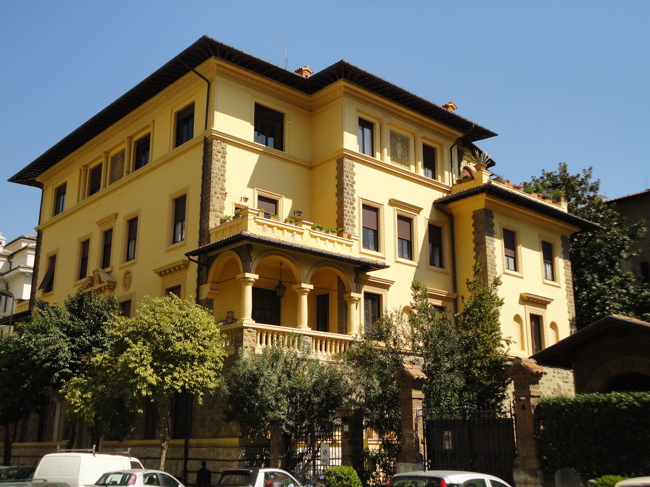
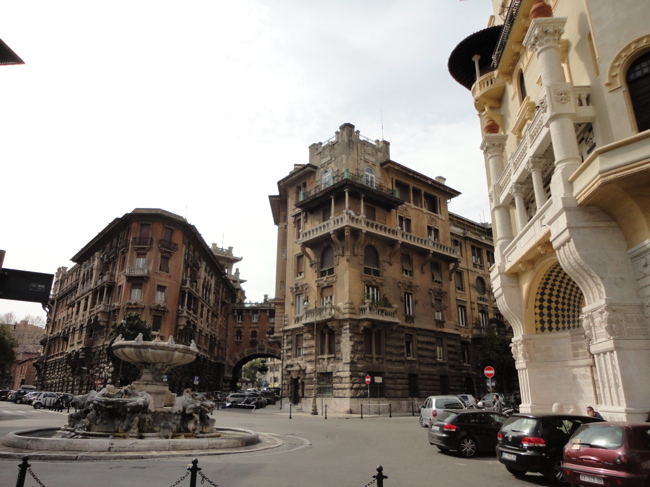
Rome has many little neighbourhoods, some like the ancient Suburbia stands just outside the area of the Roman Forum, other quartiere were built to mark an event, like the Afrika neighbourhood, all the streets are named after cities in the former Italian colonies of Ethiopia, Eritrea, Somalia and Lybia, other still like Coppede at the corner of Piazza Buenos Aires and Via Tagliamento were built in a style to indicate a re-birth of Rome as the Capital of Unified Italy. The Coppede quartiere is sandwiched between the neighbourhood of Trieste and Salario. In 1913 Gino Coppede was asked to design a series of buildings that would be unique in their architecture and a symbol of the new Capital of Italy. He chose to use a mixture of Art Nouveau and Eclectic style with elements recalling ancient Rome. In all 18 apartment blocks and 11 large villas and several smaller buildings where built. Gino Coppede died in 1927 and his work was completed by a fellow architect. Today this residential neighbourhood is much visited and admired for its uniqueness in design.

I always thought that it would be fun to live in such buildings, they are the stuff of fantasy and dreams. The apartments are large and formal with high ceilings, reminiscent of an era long gone. The years of the building of this project was also one of vast ambitions in Italy, the First World War saw Italy emerge victorious over Austria and Northern Italy was liberated from Austrian occupation. Italy also gained much territory on the Eastern Side of the Adriatic, all in the former Austrian Empire. Though the 1920's saw much political gridlock and economic difficulties culminating with the coup d'état which propelled Benito Mussolini to power with his Fascist party.

These buildings stand in stark contrast to the Fascist architecture in other areas of the City for their whimsical style if compared to the severe Fascist style. The buildings are in constant need of repair and cleaning. They are well worth it and once cleaned of the soot and grime, they are quite beautiful to look at.


Villa delle Fate, a large private house.

Piazza with the fountain of the Frogs
Palazzo degli ambasciatori newly cleaned

Sunday, 12 February 2012

Dialecto Italiano

Many years ago we were in Venice at a wonderful restaurant in a small hotel near the Accademia.
The restaurant is located in the garden of the hotel with wonderful old wisteria and old vines making a roof over our heads. At a table near by a couple was being entertained by the lady owner of this small hotel. She was a native of Venice and had spent all her life in the city. The gentleman was doing much of the talking and it was a very general conversation on Venice, suddenly his female companion chirps up, she wanted to know if their host spoke Italian or dialecto, the hostess was a little surprised by the question because the implication was that she was not educated and spoke only Venetian dialect and not Italian. We thought this was a very rude question, but as we learned years later, dialecto is spoken in Italy by many Italians and they will often know the typical dialect of their region and speak the common language Italian. The two are very different, one of the difficulties of Italian unification 150 years ago was to get everyone to speak Italian and abandon their dialect. How can you unite a country if no one understands what the other fellow is saying. Per example in Canada many Canadians of Italian origin speak dialect and not Italian, this is why often they are shy to speak with me so as not to give away the fact that their Italian is not perfect.

The hotel owner in Venice did answer the question of her guest, she told her that in Venice with other Venetians since it is their common language and same for the Veneto, but with Italians from other parts of Italy then its Italian which is in fact the dialect of Tuscany which was adopted as the common language. In Rome, there is Romanesco, in all more than 30 dialects exist and are used in the different regions of Italy. This is not so strange, until unification in 1860 most of Italy was a cluster of little principalities and Duchys and some under the Papal State.    

So when you visit Italy and you hear people speaking but you do not recognize what they are saying it is because they speak dialect. 

Friday, 3 February 2012

Snow can be romantic

It's funny how a snow storm can be romantic in one city and cause people to curse in another city. How can this be I wonder, could it be the beautiful century old buildings, the parks and landscape or simply the image we have of Rome. The snow is falling all over Italy and it is simply romantic and beautiful.

The great gates of Villa Borghese in Rome in front of Piazza Flaminia

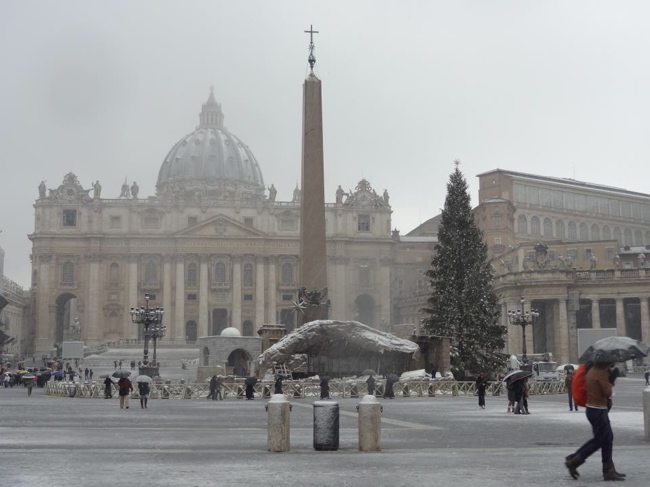
Oh my! they have not taken the tacky Xmas decorations down at Piazza San Pietro.

Taken from inside a passing car, the staircase leading to the Campidoglio with Castor and Pollux looking down from the Capitoline Hill.

Looking down Via della Conciliazione towards St-Peter which has disappeared under the snow storm.

The doorman of the Embassy of Canada to the Holy See in Rome cleaning the snow off.

As I was saying to the Holy Father this morning as he was gazing out from his apartment window down unto St-Peter's Square, we should go skiing.


on the street, where is everyone?


The beautiful cathedral of Siena under the snow.
No one at the Caffé today

un bello ragazzo

How I miss it all, as Puccini said, you will never see anywhere in the world a city has great as Rome.
I have to agree.

Saturday, 21 January 2012

Cultural Weekend

This weekend we have been to two cultural events, on Friday night to the theatre to see the famous Canadian play which has been translated in numerous languages and produced around the world in the last 15 years entitled Two Pianos Four Hands by Ted Dykstra and Richard Greenblatt. It chronicles the dreams of two boys who aspire to concert pianist stardom. Highly entertaining with lots of piano playing. It reminded me of my own days when as a youth I took piano lessons. Then this afternoon, we went to see live from New York, MET performance of The Enchanted Island by Jeremy Sams. The Metropolitan Opera has been on the radio for more years than I can remember, decades really and heard around the world.  Now its HD Live in large cinemas and it is as if you were there in person. The cinema was full and it is shown in another cinema in Ottawa, so during the MET Season seven cinemas in Ottawa pack them in to see these live performances. There is a great demand and it is hugely popular and a great way to spend a cold winter afternoon, today it was -23C.  The conductor was William Christie who was sporting his Legion d'Honneur. The Cast was Neptune, Placido Domingo, it was his birthday today, Sycorax, Joyce Didonato who we saw in Milan at La Scala, Caliban, Luca Pisaroni who we saw in Salzburg and in Ravena, Prospero, David Daniels. We had such great fun and I enjoyed my afternoon immensely. A lavish production, great music of the Baroque era. Jeremy Sams used music by Handel and others and simply put in new wording to very familiar tunes. I have to say that the wording was sort of pedestrian but nonetheless enjoyable.

Today was a sunny winter day and thousands of people were skating on the Rideau Canal, so far 4.3 km are open but next week it will be the full 11Km within the Capital. You get a full workout on such a long stretch of the skate way.
Tonight I am making chicken soup from scratch, I love to do this, it brings back such wonderful memories of my childhood and I basically copy my Mom's recipe, easy as pie and its smell wonderful.     

Thursday, 29 December 2011

What no Television

We are now at the 5 month mark since our return from Italy. Our intention was when we returned to buy a new television, we even made a date to go to the store and look at models, the latest technology with gadgets etc.... This was in August, we were still unpacking and moping for la bella Italia, boxes everywhere and chaos. So we postponed our trip to the shop and then simply forgot about it. It turns out that we did have a large flat screen TV in Rome but never watched it, we always had other things to do or things to go and see, so the television just sat there. Now last weekend we were in Montreal and our hotel room had a large screen TV, we turned it on mostly for the puppies as background noise when we were not in the room to distract them. I did watch a bit of news but overall I found the contents of what was being presented on various and numerous channels totally vapid and of no interest to me what so ever.
The talking heads in most cases, no in all cases had no idea what they were talking about, just flapping their gums about this and that and finding themselves very funny, I just found them boring, sorry Radio-Canada and CTV. Most announcers on television are so pretentious and so full of their own importance its comical, they are also desperate to look just like everyone else on the street, faux common bond. They are dying to tell you what is new and hip and why you should do like they do, because their mothers or someone in their family think its great. They got their finger on the pulse of things, really?  All this to say that I would not buy a television set based on what I saw on television. I found most announcers and assorted talking heads good reasons not to get involved with the thing to begin with.

At Christmas lunch at one point the conversation turned to a series on television, I had never heard of it
neither had Will.  We told family that we did not own a television set and did not plan at this point to get one. We got strange looks, in North America the television culture is deeply ingrained and is part of everyday life, no one really thinks of doing without a television.  We have come to realize that we are a breed apart, too much travel, too much living abroad, too many different experiences. We are on a sort of permanent jet lag. So we will continue to do without a television for the foreseeable future.

Thursday, 8 December 2011

Colonna dell'Immacolata, Piazza di Spagna, Roma, Italia

Today is 8 December and in Rome the Catholic Church celebrates the Immaculate Conception.
This is still to this day in Republican Italy a National Holiday. The Pope will travel from the Holy See on Vatican Hill to Piazza di Spagna usually taking a route were he will cross the Tiber River at Ponte Cavour, then down Via Tomacelli and Via Condotti turning towards Pizza di Spagna. The streets are effectively closed off thus cutting the city in two creating giant traffic snarls.  It may be a holiday but people are shopping for Xmas. He will come deposit a garland of flowers on the arm of the statue of the Virgin Mary a top the column on Piazza di Spagna with the help of the Vigili of Rome ( Fire dept) and a cherry picker. The Piazza is usually crowded on this day, so much so that the metro stop at Piazza di Spagna is closed, the crowds are too great.

All the religious congregations in Rome will come to the Piazza wearing the different uniforms of their congregation to greet the Pope, sing hymns and pray to the Virgin. Leaving at the foot of the column many flower tributes. This being Rome the whole scene takes on a Carnival air.

The column itself was taken from an ancient Roman temple, the statue of the Virgin is in fact an ancient statue of Venus, remodelled somewhat. At the foot of the column sits 4 Hebrew patriarchs from the old Testament. They represent the links to the promise made by God the Father to his people to send a Messiah.

The column stands in front of the College for the Propagation of Doctrine of the Faith, which the current Pope use to be the Head and next to the Royal Spanish Embassy to the Holy See.

Sunday, 4 December 2011

a corner has been turned.

A little over 4 months ago we returned from Italy. It was a difficult return, we had become well established in Rome and we had a routine and a life and friends. We became very familiar with the city and what it had to offer. We often also travelled around Italy to several small cities discovering a good restaurant or some are treasure or a good wine. There was always something to see either in Rome, a new exhibit, a cultural event or somewhere else outside the city, just a short train ride away.  Our departure from Rome was not helped by certain individuals who created administrative difficulties which made our move longer than necessary.  We arrived back in Canada and the settling in period started, it was not always easy, meeting with obtuse government officials, a changed city and indifference. It all looked so parochial and limited.
But this week finally a corner is turned, maybe it was that concert at Knox Presbyterian or the Christmas lights all over the city, on public buildings, in city parks or the change in the weather and the firming up of plans for the Holidays. Who knows but it seems we now have a new routine and we are finally settled.

For sure we will always have strong fond memories of Rome and of our lives and friends we left behind.
But for now Ottawa seems to be our new home and that thanks to long time friends here who have been helpful, we have been able to start a new life and look to the future and make plans.
Canadian Parliament Building, Ottawa