City Palace Berlin, Sagrada Familia Barcelone, FrauenKirche Dresden, Lower Town Quebec City, Ara Pacis Rome, Parthenon Athens.
In my life of travelling and living abroad I have come across many sights which have been resurrected from the past or cleaned up or re-built. Why do governments do it, in most cases to recapture shares of the mass tourist market, tourist want to see things they do not have back home. Per example see London like Mary Poppins or the Rome of the Popes or early Christians or see ancient monument reborn after centuries of neglect. We want to recapture the past and with our modern sensibilities pretend we are just like the ancient, though sometimes it makes for funny situations, per example one remark often heard when visiting a former Royal Palace now a museum, tourist no.1 will say to tourist no.2 Can you imagine living in a place like this, it must have been nice.
The reality is if either of these persons had lived in the past centuries, they probably would have been peasants in the fields working hard and would never have come anywhere near such a place, this because of social barriers and strict divisions of society.
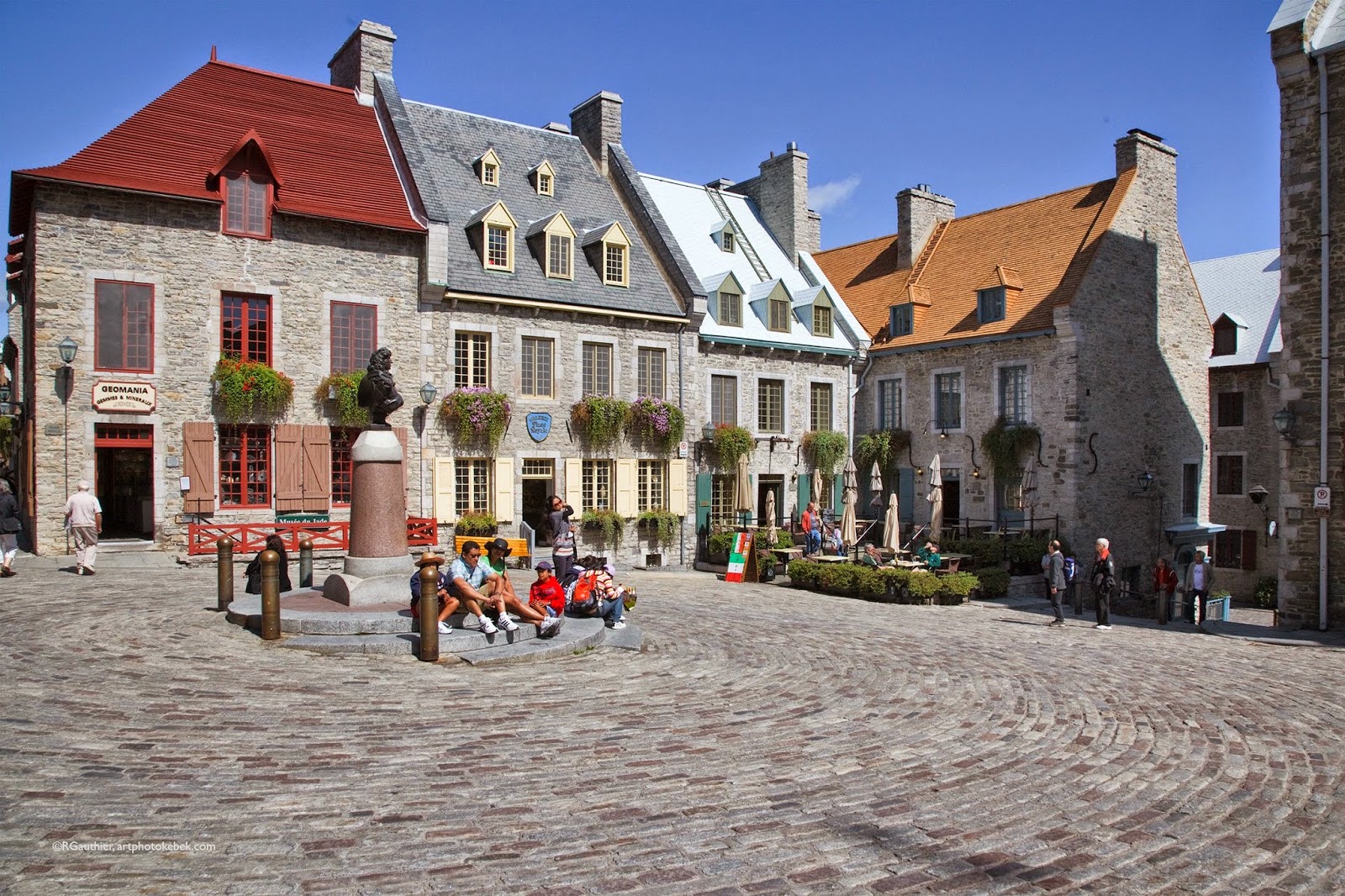
In 1962 the old City of Quebec the portion within the old Walls and the Lower town below by the St-Lawrence river dating back to 1608 was in ruins. Things were so bad the Provincial Government was considering bulldozing the whole thing and making it all modern. Luckily the Federal Government owned most of it and forbade the grand scale demolition, it also started to invest into rehabilitating the City walls, Quebec is the only city in North America with complete defensive walls and gates and dozens of stone homes from the 17th Century built in a French Norman Style. Today people from around the world come to Quebec City to see La Vieille Capitale, because Quebec was the Capital of the French Empire until 1763 and then the Royal Capital of Canada until 1820. So history is everywhere in its historic streets.


I started to visit Athens around 1998 though I had often flown over the City in the late 1980's never had I actually visited.
Athens was a small city until 1960's it is only in the last 35 years that a real estate boom has made it
into a megapolis, though the total population is 800,000. Not exactly Montreal or even Rome at 3 million people. The Symbol of the City is the Acropolis and the Parthenon built originally in 480 BC and re-built in 438 BC to honour the Goddess Athena Parthénos, ( Virginal Pallas triomphant) who protects her City and its people. The Parthenon is said to be the most perfect Doric style temple ever built.
To my mind the Parthenon is the symbol of the Western World, there is no more beautiful site than to watch the Sun rise in the morning and its rays hitting the White with a golden tinge Pentelic marble of the Temple making it shine as if it was made of gold. When you look at it you are reminded that theatre, philosophy, democracy, trial by jury, all come from this ancient site.
The statue of Athena stood in her temple until the fifth century AD when a fire destroyed it. With the arrival of Christians the Acropolis and the Parthenon suffered vandalism and then the Ottoman Turks occupied the site for many centuries until that fateful day when a Venetian Captain Morosini attacking Athens from the Sea aimed his canons on the Temple which at this point was used as a gunpowder store by the occupying Ottoman Turkish army. The explosion from the direct hit in September 1687 caused the devastation we see to this day. However in the last 25 years Greek Archeologists with funds from the European Union have worked at restoring this ancient temple and others on the Acropolis, like the small temple of Athena Nike and the main entrance gate the Propylae and the Erechtyion returning them to what they were like before the attack by the Venetian fleet of 1687. It is also a function of consolidating the buildings and preventing any further degradation. Using titanium rods on the blocks instead of steel which rust and then eats away at the marble. In some cases new marble blocks have been carved to replace those to weak or degraded. In my lifetime I can say that I have seen the Parthenon and the other temples restored or reborn. Many might say why restore such an ancient site, I think that in this case given the importance of this sacred place for us Occidentals, this hill must continue to live forever.


Despite the beauty of the reconstruction and how faithful to all the details to ensure accuracy, I was somewhat disappointed, difficult to explain, maybe it was the realization that I was not looking at the original Church or City but a faithful copy. I also wondered if future generations will understand what happened to this city in 1945, one could understand if they forgot all about it or disbelieved any tale of war and mayhem.
Moving on to Rome where nothing is ever changing or so it seems one could be forgiven for the fact that much of what we see today in Rome is often the case of the will of men to change the city to suit a political program. It is often said that Rome looks like a theatre set, every angle is like a theatre set design to attract the eye to a beautiful panorama.
First the Popes on their return from Avignon in France decided to remake Rome.
The numerous well preserved Temples of Antiquity were dismantled to be used in the rebuilding of churches and public works. Then other works of art were used to decorate palaces and gardens, often with a beautiful effect. However much was also destroyed carelessly for mercantile reasons.
Unified Italy as of 1870 embarked on a program of changing Rome to suit its new image as a Republican Monarchy opening new streets like Via Cavour and Via Nazionale in the heart of the City and building the great walls along the Tiber to prevent winter floods. Then when Mussolini came to power in 1923 he wanted Rome to reflect its imperial glory so he employed historians, archeologists and architects to find all those pieces of the puzzle that were still buried and he resurrected temples or part of them like the Temple of the Vestal Virgins in the Roman Forum or the Arch of Titus or went on to build the Via dei Fori Imperiali crossing the whole of the ancient Forum area so he could have great military parades à la Hollywood.
So when you visit Rome today the ruins you see are the work of the Fascist era (1923-1943), unwittingly Mussolini helped the Italian Tourist Industry for decades to come. Tourist have something to see.
One such monument amongst many to have been resurrected and it is a magnificent one, is the Ara Pacis Augustae (Altar to Augustan Peace) as the name indicates it was to celebrate world peace brought about with the pacifying of the Barbarian nations. A monument built as a testimony to the legacy of Octavian the nephew of Julius Caesar better known to us as Augustus the first Emperor of Rome (63BC to 14AD) and probably the greatest and best. His legal legacy still resonates with us today and is found carved in stone on the side of the building housing the Ara Pacis, the Res Gestae in Canada Lawyers call it the Law of Evidence.
The monument was built at the request of the Roman Senate in July of 13BC and was located in the Field of Mars an area nowadays around the Via del Corso and Via del Parlamento. The soil being quite soft in the area the weight of the monument caused it to sink into the ground and only 60 years later it was half buried. Eventually it disappeared completely only to be re-discovered by accident during excavations in 1568 under Palazzo Chigi and more fragments surfaced in 1859 and in 1903. Those fragments ended up in the Vatican Museum, the Villa Borghese, the Uffizi Museum and the Louvre in Paris. In 1937 to celebrate the 2000 Birthday of Augustus, Mussolini ordered that the whole monument be excavated and re-assembled in a new site by the Tiber and next to the Mausoleum of Augustus at Ponte Cavour and Via Tomacelli, a special building was also built to house the monument. That building was again completely re-designed in 2006 by architect Richard Meier. Nonetheless the Ara Pacis is a very important monument for the Western World.
I studied that monument in school as a kid and imagine how wonderful it was for me to see it in 2007 for the first time in person. Though the white marble stone today does not show the original colours, think of an Hindou Temple, every year on the anniversary of the birth of Augustus the monument is displayed at night with a show of light so the public can see it again as it was then, the bold colours are jarring to our modern sensibilities.
I visited the Ara Pacis numerous times and am still in awe of its magnificent grandeur.


Another project this one in Barcelona, Catalonia, Spain is the Church of the architect Gaudi, La Sagrada Familia under construction since 1882 it is nearing completion now due to strong tourist interest and ticket sales to visit the site. As a child I had heard of this church by Gaudi and how no one knew if it would ever be completed. Antoni Gaudi died in 1926 in Barcelona run over by a street car. After his death no one knew if the church could be completed, since it was very much his inspiration which created this masterpiece. Then the Spanish Civil War saw a great deal of chaos, the Catholic Church in Spain sided with the Fascist forces of General Franco and in Catalonia there was much repression of the population. The Church was no ones friend, the Republican lashed out and attacked the construction office where all the archives of Gaudi were kept everything was destroyed including the mock-ups of the final product. Now construction stopped completely, to add to this sad situation General Franco was victorious, he exiled the Royal Family and proclaimed himself dictator at the same time he allied himself with Nazi Germany. The Second World War saw more economic disaster befell Spain and despite being a Neutral country it was very isolated. After the war a commission of academics and other experts decided that the Sagrada Familia Church should stand as is incomplete as a monument to Gaudi. It was only in 1975 with the death of General Franco and the return to democracy and a restoration of the Monarchy that once again the construction work re-started but this time with a panel of artists and architects devoted to seeing the vision of Gaudi for his church in the completion of the project. Only having a few documents in private hands from the time of Gaudi and some of his writings to guide them, new financing was devised in organized tours of the site where tourist would pay to gawk at what was going on.
.jpg) Here is the first drawing of what the Sagrada Familia would have looked like, a design by Francisco de Paula Villar y Lozano, the first architect who would be replaced by Antoni Gaudi. Of this original design only the underground crypt church was completed in 1900. Gaudi then changed everything and started on his vision.
Here is the first drawing of what the Sagrada Familia would have looked like, a design by Francisco de Paula Villar y Lozano, the first architect who would be replaced by Antoni Gaudi. Of this original design only the underground crypt church was completed in 1900. Gaudi then changed everything and started on his vision.


There are more photos at this site http://fr.wikipedia.org/wiki/Sagrada_Fam%C3%ADlia

In my life of travelling and living abroad I have come across many sights which have been resurrected from the past or cleaned up or re-built. Why do governments do it, in most cases to recapture shares of the mass tourist market, tourist want to see things they do not have back home. Per example see London like Mary Poppins or the Rome of the Popes or early Christians or see ancient monument reborn after centuries of neglect. We want to recapture the past and with our modern sensibilities pretend we are just like the ancient, though sometimes it makes for funny situations, per example one remark often heard when visiting a former Royal Palace now a museum, tourist no.1 will say to tourist no.2 Can you imagine living in a place like this, it must have been nice.
The reality is if either of these persons had lived in the past centuries, they probably would have been peasants in the fields working hard and would never have come anywhere near such a place, this because of social barriers and strict divisions of society.
In 1962 the old City of Quebec the portion within the old Walls and the Lower town below by the St-Lawrence river dating back to 1608 was in ruins. Things were so bad the Provincial Government was considering bulldozing the whole thing and making it all modern. Luckily the Federal Government owned most of it and forbade the grand scale demolition, it also started to invest into rehabilitating the City walls, Quebec is the only city in North America with complete defensive walls and gates and dozens of stone homes from the 17th Century built in a French Norman Style. Today people from around the world come to Quebec City to see La Vieille Capitale, because Quebec was the Capital of the French Empire until 1763 and then the Royal Capital of Canada until 1820. So history is everywhere in its historic streets.
Eglise Notre Dame des Victoires, 1688
Place Royale, Ville de Quebec
Petit Séminaire de Quebec, 1664
I started to visit Athens around 1998 though I had often flown over the City in the late 1980's never had I actually visited.
Athens was a small city until 1960's it is only in the last 35 years that a real estate boom has made it
into a megapolis, though the total population is 800,000. Not exactly Montreal or even Rome at 3 million people. The Symbol of the City is the Acropolis and the Parthenon built originally in 480 BC and re-built in 438 BC to honour the Goddess Athena Parthénos, ( Virginal Pallas triomphant) who protects her City and its people. The Parthenon is said to be the most perfect Doric style temple ever built.
To my mind the Parthenon is the symbol of the Western World, there is no more beautiful site than to watch the Sun rise in the morning and its rays hitting the White with a golden tinge Pentelic marble of the Temple making it shine as if it was made of gold. When you look at it you are reminded that theatre, philosophy, democracy, trial by jury, all come from this ancient site.
The statue of Athena stood in her temple until the fifth century AD when a fire destroyed it. With the arrival of Christians the Acropolis and the Parthenon suffered vandalism and then the Ottoman Turks occupied the site for many centuries until that fateful day when a Venetian Captain Morosini attacking Athens from the Sea aimed his canons on the Temple which at this point was used as a gunpowder store by the occupying Ottoman Turkish army. The explosion from the direct hit in September 1687 caused the devastation we see to this day. However in the last 25 years Greek Archeologists with funds from the European Union have worked at restoring this ancient temple and others on the Acropolis, like the small temple of Athena Nike and the main entrance gate the Propylae and the Erechtyion returning them to what they were like before the attack by the Venetian fleet of 1687. It is also a function of consolidating the buildings and preventing any further degradation. Using titanium rods on the blocks instead of steel which rust and then eats away at the marble. In some cases new marble blocks have been carved to replace those to weak or degraded. In my lifetime I can say that I have seen the Parthenon and the other temples restored or reborn. Many might say why restore such an ancient site, I think that in this case given the importance of this sacred place for us Occidentals, this hill must continue to live forever.
Temple of Athena Nike, restored 2011
Propylae gate, Acropolis in restoration 2010
Parthenon under continuous restoration in June 2014.
The Capital of Saxony, Dresden was totally destroyed in a fire bombing by the British forces on the night of 14 February 1945, 600,000 civilians died burned alive in the firestorm. Dresden was not a strategic city and had no military value, it was known for its culture and art. Canaletto had made a very famous painting of the city in the 18th century. This painting was so accurate in its architectural detailing that it was used to rebuilt the city from its ashes after 1989.
The devastation of Dresden was total and after the end of the Second World War, Dresden was behind the Iron Curtain in East Germany. There was no money for re-building and very little effort was made to repair the damage inflicted. Most of its civilian population had died, so the Communist authorities decided to rebuilt here and there in a haphazard way outside of the old city limits. The Lutheran Church wanted it's main temple re-built because of its association with Martin Luther who had preached there. But all this re-building had to wait German reunification in 1990, from public donations from around the world the Lutheran Church was able to rebuild the Frauen Kirche of Dresden originally built by architect George Bahr in 1726 it had survived intact other wars and invasions until that fateful night in 1945.
The plan to rebuild this one church gave the impetus to massively rebuild the old city including the other churches and the Royal Palace of the Princes of Saxony, the Semper Opera house and other palaces and museum. We first visited around 1999, the old City was a field of construction and the Frauen Kirche was only half rebuilt. When we returned in 2014 most of the work was complete and the Church itself had been re-dedicated and is now serving the Lutheran Community of Dresden.
Dresden is also famous for its porcelain and the celebrated Meissen Porcelain factory. Some 23,000 pieces of 17th and 18th century porcelain can be admired in the Zwinger Palace forming the private collection of the Royal Family of Saxony. Then the beautiful Art museums and the Residenzschloss or Royal Palace and its incredible precious jewels and other rare objects collections, requiring a minimum of 2 days to fully appreciate the wealth of the collections which can now be seen as prior to 1939 in all its glory.
Dresden and the FrauenKirche on the New Market Square, 1742 by Bernardo Bellotto
Dresden re-built in June 2014
FrauenKirche re-built in June 2014
FrauenKirche in ruin after fire bombing of 1945 with the Statue of Martin Luther. Reconstruction will start in 1996 only.
Partial view inside the FrauenKirche, Dresden, 2014 (Lutheran Baroque)
Despite the beauty of the reconstruction and how faithful to all the details to ensure accuracy, I was somewhat disappointed, difficult to explain, maybe it was the realization that I was not looking at the original Church or City but a faithful copy. I also wondered if future generations will understand what happened to this city in 1945, one could understand if they forgot all about it or disbelieved any tale of war and mayhem.
Moving on to Rome where nothing is ever changing or so it seems one could be forgiven for the fact that much of what we see today in Rome is often the case of the will of men to change the city to suit a political program. It is often said that Rome looks like a theatre set, every angle is like a theatre set design to attract the eye to a beautiful panorama.
First the Popes on their return from Avignon in France decided to remake Rome.
The numerous well preserved Temples of Antiquity were dismantled to be used in the rebuilding of churches and public works. Then other works of art were used to decorate palaces and gardens, often with a beautiful effect. However much was also destroyed carelessly for mercantile reasons.
Unified Italy as of 1870 embarked on a program of changing Rome to suit its new image as a Republican Monarchy opening new streets like Via Cavour and Via Nazionale in the heart of the City and building the great walls along the Tiber to prevent winter floods. Then when Mussolini came to power in 1923 he wanted Rome to reflect its imperial glory so he employed historians, archeologists and architects to find all those pieces of the puzzle that were still buried and he resurrected temples or part of them like the Temple of the Vestal Virgins in the Roman Forum or the Arch of Titus or went on to build the Via dei Fori Imperiali crossing the whole of the ancient Forum area so he could have great military parades à la Hollywood.
So when you visit Rome today the ruins you see are the work of the Fascist era (1923-1943), unwittingly Mussolini helped the Italian Tourist Industry for decades to come. Tourist have something to see.
One such monument amongst many to have been resurrected and it is a magnificent one, is the Ara Pacis Augustae (Altar to Augustan Peace) as the name indicates it was to celebrate world peace brought about with the pacifying of the Barbarian nations. A monument built as a testimony to the legacy of Octavian the nephew of Julius Caesar better known to us as Augustus the first Emperor of Rome (63BC to 14AD) and probably the greatest and best. His legal legacy still resonates with us today and is found carved in stone on the side of the building housing the Ara Pacis, the Res Gestae in Canada Lawyers call it the Law of Evidence.
The monument was built at the request of the Roman Senate in July of 13BC and was located in the Field of Mars an area nowadays around the Via del Corso and Via del Parlamento. The soil being quite soft in the area the weight of the monument caused it to sink into the ground and only 60 years later it was half buried. Eventually it disappeared completely only to be re-discovered by accident during excavations in 1568 under Palazzo Chigi and more fragments surfaced in 1859 and in 1903. Those fragments ended up in the Vatican Museum, the Villa Borghese, the Uffizi Museum and the Louvre in Paris. In 1937 to celebrate the 2000 Birthday of Augustus, Mussolini ordered that the whole monument be excavated and re-assembled in a new site by the Tiber and next to the Mausoleum of Augustus at Ponte Cavour and Via Tomacelli, a special building was also built to house the monument. That building was again completely re-designed in 2006 by architect Richard Meier. Nonetheless the Ara Pacis is a very important monument for the Western World.
I studied that monument in school as a kid and imagine how wonderful it was for me to see it in 2007 for the first time in person. Though the white marble stone today does not show the original colours, think of an Hindou Temple, every year on the anniversary of the birth of Augustus the monument is displayed at night with a show of light so the public can see it again as it was then, the bold colours are jarring to our modern sensibilities.
I visited the Ara Pacis numerous times and am still in awe of its magnificent grandeur.
West side
East Side
Members of the Imperial Family, all can be identified by name.
One monument which is being re-created from scratch is the City Palace of Berlin, for centuries this was the Palace of the Princes of Brandenburg, then the Official Palace of the Prussian Kings and finally the Palace of the German Emperor until 1918.
The palace was bombed and burned in 1944 but could still be restored, however with the partition of Germany in 1945 it fell in the Eastern Sector of the City and the Communist authorities decided to blow it up in 1953 to make way for a military parade ground instead, more goose stepping.
The palace was in an area of Berlin which housed a unique complex of buildings, university and museums at the end of the ceremonial road Unter den Linden (under the linden trees) which starts at the Brandenburg Gate. The palace was located on an island on the Spree River next to the Lutheran Cathedral and all the museums housing the various art and archeological collections.
As of 1990 the new united City of Berlin and the Federal Government of Germany decided to renovate all the historical buildings of the Eastern sector left derelict by the Communist government for decades. In fact in 1985 the East German government had threatened to blow up every historical building in its sector if the West German government did not pay the full price of reconstruction. Had this plan gone ahead much of the 800 years of the history of Berlin would have been lost forever.
Berlin has been one huge rebuilding project since 1990, it's infrastructure, the rail system, the U and S ban and its real estate all of it renewed or rebuilt. The Lutheran Cathedral, the various museum on the island and every other monument and palace rebuilt. Frederick II the Great is back on Unter den Linden riding into the City again a top his monument. The one missing link was the City Palace, it took years of discussion and consultation and finally the Federal Parliament (Bundestag) sitting in the rebuilt old Reichstag building voted in favour of rebuilding, the City of Berlin also supported the plan. However first the old East German Parliament building had to be demolished and that took 3 years when it was discovered the building was full of asbestos.
Palast der Republik, GDR, Berlin in 1977
The idea is to rebuild the palace on the outside as it was before 1918 and make of the interior a modern University conference centre and library with museums on foreign cultures. It will be called the Humboldt Forum after the German brothers Alexander and Wilhelm Von Humboldt. With the palace rebuilt the entire area will have a homogenous architectural look recalling the 18th Century and the age of Enlightenment.
What the rebuilt City Palace or Humboldt Forum will look like in 2019.
I have been following the entire saga since the beginning in the 1990's and this December construction of the shell of the palace is complete. Though the Federal Government of Germany will pay for the entire completion of the inside of the structure the decorative Baroque elements on the outside must be paid for by private donations and at the moment some 60 Million Euros still need to be raised, completion date 2019. It should be said that a lot of controversy surrounds this project, though now it is well on its way to be completed. Though it is only to fulfil a wish to have the city centre whole that this project was put forward, many advocated that something different be built. However historically speaking for 600 years a Palace stood in this place. See the link
http://berliner-schloss.de/en/humboldt-forum-new-palace
You can see a photo of today 1 Dec 2014 at 21:05 Berlin Time and how advanced the construction of the Palace is at this point, they are at the roof top.
http://cam01.berlinerschloss-webcam.de/?id=1417459501
http://berliner-schloss.de/en/humboldt-forum-new-palace
You can see a photo of today 1 Dec 2014 at 21:05 Berlin Time and how advanced the construction of the Palace is at this point, they are at the roof top.
http://cam01.berlinerschloss-webcam.de/?id=1417459501
Another project this one in Barcelona, Catalonia, Spain is the Church of the architect Gaudi, La Sagrada Familia under construction since 1882 it is nearing completion now due to strong tourist interest and ticket sales to visit the site. As a child I had heard of this church by Gaudi and how no one knew if it would ever be completed. Antoni Gaudi died in 1926 in Barcelona run over by a street car. After his death no one knew if the church could be completed, since it was very much his inspiration which created this masterpiece. Then the Spanish Civil War saw a great deal of chaos, the Catholic Church in Spain sided with the Fascist forces of General Franco and in Catalonia there was much repression of the population. The Church was no ones friend, the Republican lashed out and attacked the construction office where all the archives of Gaudi were kept everything was destroyed including the mock-ups of the final product. Now construction stopped completely, to add to this sad situation General Franco was victorious, he exiled the Royal Family and proclaimed himself dictator at the same time he allied himself with Nazi Germany. The Second World War saw more economic disaster befell Spain and despite being a Neutral country it was very isolated. After the war a commission of academics and other experts decided that the Sagrada Familia Church should stand as is incomplete as a monument to Gaudi. It was only in 1975 with the death of General Franco and the return to democracy and a restoration of the Monarchy that once again the construction work re-started but this time with a panel of artists and architects devoted to seeing the vision of Gaudi for his church in the completion of the project. Only having a few documents in private hands from the time of Gaudi and some of his writings to guide them, new financing was devised in organized tours of the site where tourist would pay to gawk at what was going on.
Floor plan of the Sagrada Familia by Gaudi.
The current construction schedule is going well and the Church is well on its way to be completed after 70 years of sleep. At this time though it is not clear if the main front entrance of the Basilica the Portico of Glory will be completed, the reason is that it now stands above a express train tunnel (Paris -Barcelona) and the vibration of this high speed train as it enters Barcelona may affect the front of the building. Also in 1975 the land immediately across the street was sold to a developer in what many see as a shady land deal. So the great staircase and plaza planned for the area cannot be built now since condominiums occupy this land.
Glory Portico which may never be finished.
The Passion Portico and the Nativity Portico face parks and can easily be admired. Maybe in a way given the tortuous story of the construction of this church it is better if part of it remains unfinished.
Certainly the rest 90% will be completed by 2026, sone 144 years after the beginning of the work.
What is wonderful about this construction is that all the funds came and still come from private donations and tourists buying tickets to visit the site.
Panoramic view of the ceiling vault of the Sagrada Familia, Barcelona.
This view is dizzying but given the high luminosity of the Church and the multitude of stain glass, the gold on the ceiling, your eyes are really seeing a marvellous feat of architecture. The columns are not painted, they are stone and they take on various shades of colour as the Sun illuminates the building, this changes as the hours pass. The most magical of effect.There are more photos at this site http://fr.wikipedia.org/wiki/Sagrada_Fam%C3%ADlia
The basilica in 2014.
There are many more projects around the world, St-Petersburg is another one where dozens of Palaces have been meticulously restored and turned into museums or hotels. A whole generation of Russian artisan is being trained to produce furniture and other objects but also trades in refurbishing these historical buildings. This could be another entry unto itself.
In Asia Japan, Vietnam and Cambodia have projects to redo sites which have been neglected or abandoned. China redid its Forbidden City in advance of the Olympics games a few years ago, though unfortunately with little care for historical accuracy.
In Asia Japan, Vietnam and Cambodia have projects to redo sites which have been neglected or abandoned. China redid its Forbidden City in advance of the Olympics games a few years ago, though unfortunately with little care for historical accuracy.


