Tuesday, 6 November 2012

Greenwich on the Thames, London

I remember years ago when I was in Egypt and we would listen to the BBC World Service for the signal at the hour coming from Greenwich where the famous meridian is located, we would set our watches on this signal. There is another meridian that one in Beijing and crosses the Tian An Men square, though Greenwich is the famous one.

I had heard of it but never visited the site of Greenwich, located further out than the Tower of London and across from Canary Wharf, I always thought it a fair distance but really it is not.

Greenwich has been many things, the site of a Royal Palace, a Naval School, a hospital for sailors and a scientific research station with its own telescope and the site of the famous meridian. At an international conference in October 1884 it was established by 44 participating countries that Greenwich would be the mean meridian on a 24 hour clock and this way all countries around the world would establish their time zones based on the Meridian of Greenwich. To this day the only country in the world not to adhere to this system is CHINA, Beijing time is the only one for the entire country, meaning that it is the same time where ever you may be in China. A little jingoism on the part of the Communist Party.
The main buildings of Greenwich, the great Hall to the left, the Queen's House in the middle and the Chapel on the right. The seating area is being dismantle it was part of events for the Olympics this past summer.

We sailed from Westminster Bridge down river towards Greenwich, it was a cold and blustery day with ever changing skies. I had never seen the City from the river. Arriving at Greenwich you are met by the Cutty Sark now beautifully restored. You can easily spend the day at Greenwich it is a large complex and park, so many details and so much to absorb with some of the best views of London. They had some Olympic competition during the summer and are still dismantling the seats and re-soding the great lawns.  The is also a monument to General James Wolfe next to the observatory. I really do not understand what Wolfe is doing there, what did the Seven Years War (1756-1763) and the Battle of Quebec City have to do with Greenwich, am not sure. The monument was unveiled by the descendant of his adversary the Marquis de Montcalm, the unlucky commander of the French Army. I do note that the monument is pock marked with bullet holes as if someone shot up the stone plinth.
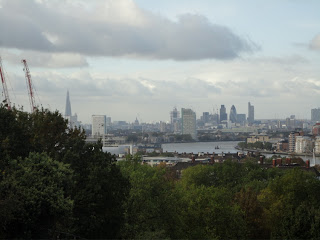

A view from the hill looking towards Westminster, on the left you can see the new skyscraper called the Shard it is located near Waterloo Station. I do not like it, it looks inhuman or sic-fi.


Street view of Greenwich

The Cutty Sark, now completely restored.

The Bradly Observatory at the top of the hill of Greenwich. The view is spectacular.


The great Hall which is or was used as a banquet hall.


The apotheosis of Admiral Nelson whose body (note the bare feet indicating death) being held up by winged Victory is handed over to Britannia. Nelson is buried at St-Paul's Cathedral with the Duke of Wellington.

Greenwich buildings and park is a very large space and give yourself time to explore and look at the site including the Naval Museum which is very well done and interesting. Walk in its beautiful park and look for the Meridian line on the ground. I am glad I finally went to see it. Maybe go on a warmer day with less wind also helps, I needed a pair of gloves.


Monday, 5 November 2012

New photo

I was at a conference last week and they offered free professional head shots. I thought what a good offer.

I am rather pleased with the results, will use this as my new icon photo and photo for other official use.


Sunday, 4 November 2012

Cooking classes


Today in the kitchen Will was cooking look at the two attentive children of Cerberus, it is cooking class time for Nicholas and Nora.


Of course they want to learn and taste the pork ribs. Nothing could move them from their spot.
To go with the cooking a little Waltz by Prokofiev, what cultured little Dachshunds we have.

The Houses of Parliament at the Palace of Westminster

Under sunny skies with a cold wind went to visit the Houses of Parliament at the Palace of Westminster. In ancient times around 1099 and up to 1547 this was a Royal Palace and Kings lived in a group of buildings. Only after the death of Henry VIII did his son Edward VI give the palace to Parliament and it met in Saint-Stephen's Chapel from 1547 to 1834. What the Parliamentarians inherited was in a ramshackle state, not what you see today.  So the buildings we see today were built between 1840 and 1870 by John Barry and Augustus Pugin. Inaugurated by Queen Victoria when she was still a young Queen. What is truly old of the entire complex is Westminster Hall built by Rufus the son of William II in 1099. This is where all visitors assemble before starting on the tour. This magnificent hall has seen a lot of history, more recently this is where Queen Elizabeth, the Queen Mother was lying in State prior to her funeral.
The great stain glass window in Westminster Hall.

The Westminster Hall was the seat of the Royal Law Courts until 1822. Many famous trials took place in this great hall, Thomas More, King Charles I, Robert Deveraux Count of Essex, Guy Fox, all condemned to death. Oliver Cromwell was proclaimed Lord Protector in 1653. Truly this great hall is the history of England.
Oliver Cromwell, the Lord Protector.

We then ascended the steps and turned left entering St-Stephen's Hall which use to be a Chapel until 1547, the Commons met in that room for many centuries until the great fire of October 1834.

The tour starts at the Sovereigns gate which is the entrance at Victoria Tower. The reason for this is to illustrate to the visitor that 3 elements form Parliament, 1. the Sovereign, 2. the People (Commons) 3. the Peers (Lords) all 3 elements only meet one day a year when the Sovereign Queen Elizabeth comes to Parliament to read the Speech from the Throne. For Canadians this is just like our own Parliament in Ottawa, the ceremonial and its significance is just the same, some years the Queen will read the Speech from the Throne other years it will be the Governor General.
The Royal Robing Room

The ceremonial is explained by the guides, we were shown the robing room were the Sovereign will put on the robes of State and the great train which requires 4 male pages to carry it otherwise she would never be able to walk forward it being so heavy. The Imperial State Crown weighs about 5 lbs meaning its like wearing a big bag of sugar on your head and she alone must  put it on and adjust it. Attendants are not permitted to help, the Crown is considered Sacred and a symbol of Authority, only the Sovereign can handle it.
The room where Queen Victoria had her question about that fresco.

The procession would go through an anti-chamber on its way to the House of Lords where the walls hang with frescoes, our guide pointed out one such fresco in which the Duke of Wellington on his horse at Waterloo is seen shaking hands with the Prussian General Blucher. Apparently Queen Victoria was puzzled by this scene and on her way to the House of Lords, stopped and asked if this handshake had ever really taken place, she could not remember anyone ever telling her this. The event depicted was well within living memory and Wellington was still alive. Panic ensued no one knew exactly what to answer. She was finally assured that yes they did shake hands on the battlefield and the procession continued. The House of Lords is very ornate with Royal Symbolism, the prominent colour is red.

The House of Lords or upper chamber of Parliament where the Queen reads the Speech from the Throne. The Speaker does not sit on the throne but on the big red cloth bag in front of it. The bag is filled with wool as a symbol of trade and wealth.


We then proceeded down the corridor to the other end of the building to the Commons, whose predominant colour is green. The room is laid out like the Commons in Parliament in Ottawa, though it is smaller despite the fact there are 50% more members of Parliament in London. The decor is sombre and plain a sharp contrast with the House of Lords. Our guide explained that the main power of the Commons rests in questions of finance and money bills. No taxes shall be imposed by the Sovereign without the assent of the Commons. Any government who looses a vote on a budget bill is automatically defeated and a general election is called. I was somewhat surprised by the small size of the room, I am more familiar with the House of Commons in Ottawa which is a far larger room and more airy, though the layout is similar.
The Commons, the Speaker sit on his chair at the front of the room, the Sovereign cannot enter this room ever. When Parliament meets the Sovereign in the House of Lords will send the Gentlemen of the Black Rod to fetch the Members of the Commons to come to the House of Lords to meet. The Sovereign will say with haste immediately and the Members will, by tradition, come slowly instead. 


During this tour, men must take their hats off, it is forbidden to wear a hat out of respect for the institution of Parliament. No chewing of gum and no food or drinks, no photos either. You cannot sit anywhere despite lots of comfy chairs. You should be quiet, no cel phones or other electronic devices. The guards keep a watchful eye and don't try it. The tour takes about 90 minutes, it is very interesting.


Came away from this visit with a renewed sense of how important Parliament is as an institution. The Ceremonial and symbolism is steeped in history and very important to our democracy.


The Victoria Tower at the foot is the Sovereign's entrance.


The Garrick Club, London and Lord Frederic Leighton's House

I was invited to the Garrick Club in London steps away from Leicester Sq. in the theatre district. This is the Club of theatre people and it is also one of the most prestigious Clubs in London. The walls are covered with portrait paintings of famous actors and countless mementos which belonged to all these great theatre people. An old fashion club with lots of sterling silverware, leather chairs and the air of exclusivity. Only men can be members at the Garrick Club though women can come as guests. Exactly what a men's club should be. Even the toilets are in the old style with soaps and cologne, clothes brushes and fresh towels, a wonderful place.
The bar prepares perfect cocktails and one only needs to ring the bell for the waiter to come and refresh drinks. It is as if time stood still, it has a large variety of wines and champagnes, the way bars use to be.


The Club is named after David Garrick (1717-1779) the most famous actor of 18 century England. His father had immigrated to England from France and the family name was originally Garrigue.  Garrick became director of the Drury Lane Theatre in 1749 and remained there for 30 years. He is buried in Westminster Abbey in the Poets corner. There are so many famous actors names associated with this Club that your head is spinning a real who's who.

To become a member one must be proposed by other members and it can take up to 7 years. The selection is said to be done on the basis that '' It would be better that ten unobjectionable men should be excluded than one terrible bore should be admitted''  


When you enter you see the porter first who will greet you, if you go up the great staircase to the bar you will be greeted by the barman and the waiter. All the staff know the members and in turn the members know the staff. Once you have entered the portico of this great club you have passed the threshold into a world of old charm, traditions and civility.


Earlier I went to see the private house of Frederic Lord Leighton at 12 Holland Park Rd. he was the most famous artist of his day very much into the Arts and Crafts movement. He died in 1896 and the house is a reflection of a man of taste in late Victorian era. A real gem of a place and well worth a visit. Born into a wealthy family, his father was a physician to Queen Victoria and his grandfather had been a Court physician to the Tsar of Russia. Leighton was an intimate of the British Royal Family. This meant that he could devote his life to painting and traveling. The became the President of the Royal Academy of Arts in London and upon his death the house and contents were put up for sale, Leighton had promised a sum of money to the Academy but it was not readily available. So though the house is quite large, it only has one bedroom and could not be sold. The contents paintings and furnishing were dispersed at auction by Christie's. However in the last 100 years much of it has been given back to the museum or bought back and you can now see what the house was like when Leighton lived there.


Though is style of painting today may seem passé it is still beautiful and gives us, moderns, a glimpse into another world and how people lived. He has his mausoleum in St-Paul Cathedral next to General Gordon of Khartoum.

Frederic Lord Leighton, self-portrait


Acme and Septimus


Daedalus and Icarus


Saturday, 3 November 2012

Hampton Court

Hampton Court the former country Palace of Cardinal Wolsey, the all powerful advisor, handy fixer and top diplomat of King Henry VIII is a beautiful place to visit. When the Cardinal died in Leicester knowing that he was going to be arrested and tried for treason, his palaces, Whitehall and Hampton Court were confiscated by the King who transformed Hampton Court, enlarging it and making it the centre of his Court and Royal power. It will remain a Royal Palace to this day, though since 1838 no member of the Royal family has lived in it. The Chapel is still a functioning Royal Chapel and has Officers of the Court appointed by HM the Queen to oversee it and the Palace.

In the18th century William of Orange and his wife Queen Mary transformed the Palace and gardens into a Baroque fantasy. Of the Hampton Palace of the time of Henry VIII about 50% remains and can be fully appreciated including the garden and the famous maze.

We often associate Hampton Court with movies about Henry VIII and Ann Boleyn. However she was only one part of his life, they knew of each other for about 12 years and the story is far more complicated. As you go through the Palace you start to appreciate the story of the Tudors. His father was Henry VII who defeated Richard III of York, despite this military victory at Bosworth he was insecure about his power. The first wife of Henry VIII was Catherine of Aragon whose parents were Queen Isabella and King Ferdinand who funded the trip of Christopher Columbus to the New World. He was married to her for 20 years and they had 6 children, all of them died at birth or as small infants except one, Mary who would become years later a fanatical Catholic and called Bloody Mary for her reign of terror and religious warfare between Catholics and Protestants. Henry VIII also had a son Edward VI who will become King at the age of 9 only to die at the age of 16. The one child of Henry VIII who will mark the world in the age of Shakespeare is Elizabeth I. She came to the throne having lived in fear most of her life because she was seen as a threat by her Catholic sister Mary who kept her under house arrest for many years. When Mary died and the Lords came to see Elizabeth to tell her she was now the Queen, she was convinced she was going to die.

The Palace is a living museum, the day we visited we were greeted by the Earl of Hertford and his wife, waiting for the Ambassador of the King Francis I of France, the year is 1545.  We are one year away from the death of Henry VIII. The visitors are asked to play along and it is a lot of fun, you are given lessons in Court Protocol. The King appeared with his last wife Katherine Parr and we, the public, are part of the Court. Trumpeters announce the arrival of the King and the game is on.

The baroque part of the Palace under William III and Mary II (1689-1702) as married co-rulers is also fascinating, lots of porcelain that Queen Mary loved to collect, its everywhere. Beautiful furniture and gardens, a very different age, the age of Princes. It is maybe easier to appreciate because it is closer to us in terms of timeline.

Hampton Court Palace, former home of Cardinal Wolsey and later home of Henry VIII. The red brick middle portion was 2 floors higher at the time of Henry VIII it will be lowered to the current proportions about 100 years later in a re-modeling scheme.

  Trumpeter announces the arrival of important State guests and the King.


Great stain glass window installed at the time of Queen Victoria to the glory of Henry VIII, considered to be to this day as one of the greatest of English Kings.

The King's table set for a feast in the great hall.

The King enters all kneel and men take their hats off.

How to behave at Court

The King speaks with the Ambassador of the King of France.

The clock installed by Elizabeth I still works today


The son and heir Edward VI at age 10. Will not live to be very old, he was a sickly boy.


The French diplomats in the gardens of Henry VIII. In summertime they would be full of flowers.

William III and his wife Mary II will transform Hampton Court. Though William did not speak English and never learned the language, he also did not like the English nor the country and will spend much time back in Holland leaving Mary to rule alone.


The palace built at the back of Hampton Court is connected to the old building by a courtyard and a colonnade. Here the gardens in French style of 18th century.

The gates on the Thames river at the back of the Palace were people arrived by boat from London.


The palace of William and Mary, the old section of Hampton Court is behind it

 Sculpted trees form part of the gardens.


The dining room of William and Mary, the section at the back is a cold room where wines and ice cream was kept before serving to the King and Queen.
The great State Bedroom of William III, he did not sleep in this bed this was used for the ceremony of the evening when the Court came to say goodnight to His Majesty. He would sleep next door in a much more comfortable and cosy bedroom.


William III Royal Toilet, an attendant was on duty to come retrieve the box and empty and clean it. It is located in a small room just off the office of the King.

William III Office, small and functional. The king had his back to the fireplace in order to stay warm.


William and Mary's gardener the famous Lancelot '' Capability '' Brown

Old painting of Hampton Court at the time of Henry VIII seen from the Thames river.

Thursday, 1 November 2012

Euripides in English

Went to the Seat of the European Union in England, Europe House on Smith Sq near the Palace of Westminster to see a special cultural event, it was the presentation of the play Paris Alexandros by Euripides. Written some 2500 years ago, when theatre was being invented by the Greeks. It is part of a trilogy of plays written at a time when Athens was expanding its empire into greater Greece meaning Sicily and Southern Italy. The most famous of the trilogy is the play The Trojan Women, the two others were lost, Paris Alexandros is only partially complete. Nonetheless it is a fascinating story that of Paris who meets 3 Goddesses and makes a bad choice angering the powerful Athena Goddess protector of Troy and giving himself to lust by going with Artemis the Goddess of Sparta. There he will meet the most beautiful women of Sparta, Helen, kidnap her and seal the fate of his city Troy.
Paris is a bad boy and has many faults and Cassandra his sister will try in vain to warn their parents King Priam and Queen Hekabe of the dangers of Paris, of the fulfilment of the prophecy to no avail, calling for his death to avoid the Trojan wars.

The group Dionysia (AOD) composed of famous names of the British Theatre present such plays to school groups in order to foster a love of theatre, in this case ancient theatre.
This is a great group, you can visit their web site at: www.actorsofdionysus.com

Lady Lucy French, whose grandfather Field Marshall Sir John French created the version of the British Poppy we wear at this time of the year in England and in Canada in Remembrance of all our War Dead (1914-1918), also provided important support as did the Hellenic Foundation and the Embassy of Greece.

Such evenings in London are especially nice, got to meet and speak with actress Fenella Fielding and actor Nigel Anthony, Joseph Wickes, Tamsin Shasha. Also met author David Stuttard who was instrumental in putting this recreated play together.

Europe House, seat of the European Union Office in London on Smith Sq. near Parliament.

From Smith Square you can see the towers of Westminster Abbey

The Church of St-John on Smith Square in London, today used as a concert hall.

Homes on Smith Square dating from 1726. Expensive real estate given the prestige of the proximity to Westminster Palace and Abbey.


The Victoria Tower of Westminster Palace.