Showing posts with label popes. Show all posts

Wednesday, 22 January 2014

A renovation project

When we lived in Rome just a block away from our home was the Villa Torlonia, a great park which once was the summer home of the Princely Torlonia Family. The Torlonia family originally came from the Auvergne in France, bakers who had a contract to supply daily all the bread for the army of Napoleon Bonaparte. When the French Emperor invaded Italy he needed bread for his troops and le boulanger Marin deTorlonie supplied the bread. You can well imagined that he became very rich, very quickly, he had about one hundred thousand mouths to feed daily.

Marin de Torlonie changed his name to the more Italian sounding Marino Torlonia became a cloth merchant and banker in Rome, he was a clever fellow and he became Pope Pius VII banker who in turn bestowed upon him Nobility titles, making him Duke of Bracciano.

By 1860 when Garibaldi and Cavour united all of Italy into one single Kingdom the Torlonia family rivalled in wealth the Prince of Savoy now King of Italy.

Giovanni Torlonia son of Marino was now also Prince of Civitella Cesi and Duke of Poli e Guadangnolo. He married a rich German heiress and went on to build his summer home Villa Torlonia on Via Nomentana just a few yards outside the Porta Pia gate in what was then considered the countryside.

He also accumulated several other Palaces which the family still owns to this day, among them the
Torlonia-Giraud Palazzo on Via della Conciliazione which is the street leading to St-Peter's Basilica.
The Nunez-Torlonia Palazzo on Via Bocca di Leone, the Villa Albani on Viale Regina Margherita.

The Torlonia family married well, with branches in the Royal Family of Spain, Prince Alessandro Torlonia married the Infanta Beatriz of Spain. The current Prince is also a Gentleman of the Papal Court, the correct title is Prince Assistant to the Papal Throne. An honour shared with Prince Marcantonio Colonna.

Main gate entrance to Villa Torlonia on Via Nomentana

When visiting Rome, the Villa Torlonia on Via Nomentana is worth a stop and a visit. It is famous for other reasons, it was between 1923 and 1943 the principal residence of Il Duce Benito Mussolini and his family. The Torlonia were prominent Fascists and the Prince rented out his palace and the park to the Duce for the annual symbolic sum of 1 Lira.

The Palazzo where Mussolini lived until 1943.

At the fall of Mussolini in July 1943 which was orchestrated by his son-in-law Count Ciano, the park and the palace of the Villa Torlonia where quickly abandoned has the population of Rome vented its anger by looting and burning the buildings. The ruins were used by the British Army for a few years. Then the park itself was simply open to the public, it was in a very sorry state, the buildings some were left with only charred remains and the great park was simply left unattended until 1998 when the city of Rome decided that it could no longer tolerate the situation. Prince Torlonia was convinced to give the property to the City since he did not wish to restore it himself. The complex sits in a fashionable area of Rome and it was decided to rehabilitate the whole by stages given the astronomical cost of re-building and cleaning it all.

The house of the Owls which is situated a few yards away from the Palace

From the beginning it was decided that the project was to show how a great Princely family lived in Rome in the mid-19th century. First the park was rehabilitate with new trees and flower beds, the various faux antique temples were cleaned and made safe. Then the library building was restored to house various exhibits of artists. The old stables were made into administrative buildings and the old Citrus tree hot house which has is built in a medieval style was turned into a restaurant and day care centre. The main house which was the residence of Il Duce was totally restored in the original baroque style in vogue when the Torlonia lived there before 1923. Only the bedroom of Mussolini and his wife is furnished. By 2007 the park was a very pleasant place to walk and sit quietly. The House of the Owls was also restored and re-opened.

What remained to be rebuilt was the old exotic plants hot house built in an ornate Moorish style at the bottom of the park and the great theatre. For both buildings funds from the European Union were secured given the complexity of the work at hand.

The theatre in ruins prior to the start of the restauration and re-building in 2007.

I remember both buildings in 2007 has being nothing more than a few dirty half demolished walls overtaken by weeds and plants. The theatre building was a wedding gift of Prince Alessandro Torlonia to his bride Princess Teresa Colonna. Building started in 1841 and only completed in 1874 it was only used once in 1905. The princess is buried in front of the theatre in the great column with her Urn sitting at the top. The original frescos where done by Constantino Brumidi who painted the frescos of the Capitol in Washington D.C.

the theatre restored 2014

The work on the theatre was very slow and laborious, the interior was richly decorated and the various artisans and artists had to reproduce what had existed in 1874. Using drawings, sketches and documentation on the building. The same for the Moorish Green House, which is a pastiche of what an Islamic style building would look like, remembering that at one time the Oriental style of decoration was very much all the rage in Europe.

 the semi-circular glass gallery facing south and used as an indoor garden 

 the amphitheatre area 

The side corridors leading to the amphitheatre, decorated in Roman Imperial style


The ballroom in the Palazzo. 

By looking at those pictures of the restoration work, you can appreciate the incredible work and craftsmanship that went into re-building those buildings in the park of Villa Torlonia.

Below are the photos of the Moorish Green House at the bottom of the garden of the great park. Like all great houses, there was a need to have fresh flowers and citrus trees in quantity, lemon, orange, lime, pomegranate, flowering trees of all kinds and palms. In the warm months they would be scattered all around the park but in the colder months they would be brought to this building. The roof is all glass and the walls are coloured glass.  This is quite a large building and the lavish decorations show that the owners could afford the best. By 2007 the building was a ruin, very little survived and it was difficult to imagine that it could be brought back to life. But as the pictures show, it was completely restored.

Front of the Moorish House  

Side wall of the Moorish style green house.


Friday, 27 December 2013

One Year Later, 28 December

So we are now at the close of 2013, in terms of world events well we had the usual disasters, wars, massacre of population and very little Peace on Earth. One Supreme Pontiff resigned not the first to do so in the history of the Holy See replaced by the first Jesuit ever to reach that exalted position. The new Pontiff  is a very good PR man and knows how to catch people by surprise, in a way the old Polish Politician Jean-Paul II could not, despite all the Media hype. We have also come to learn of his role and lack of action in the whole child abuse scandal. Of his powerful friends who were deeply involved and were he failed to act because he was pursuing a political agenda closely tied to Polish Politics. A moral failure on his part in my view which does not deserve his elevation to Sainthood. Luckily Pope John XXIII (1958-1963) will also be elevated to Sainthood, a much more deserving choice.

Then the Civil War in Syria, we came close to a military intervention again in a conflict the West did not understand and had little interest, though for reason of public policy politicians had to show the masses they cared. Once the matter of the chemical weapons was settled, the West lost interest and the Civil War continue apace. As for our so-called friends in the Syrian Opposition it looks like Russia knew all along that they were not trustworthy and President Assad is the devil we know, a classic case of I told you so, the Russians are laughing now and the Americans well have poor quality intelligence but then again that is not new. The series of articles in the New York Times of 29 Dec 2013 explain the whole Benghazi affair and the many failures of the CIA, yet again.
Then there was Egypt and Morsi and the Brotherhood. The Egyptian crisis will continue for some time to come, not to mention the many crisis in the whole region, Tunisia, Algeria, Yemen, Qatar.
Iran elected a new President it appears some change may be at hand, will see. Hopefully no war with Iran it would be a huge mistake. The so called Arab Spring that was not really a change for democracy, how can you have democracy with extreme poverty, lack of economic opportunity, illiterate people, lack of basic sanitation and clean water and corruption. It looks almost like a luxury this democracy thing. In North America we are very naive, too often thinking that people want to copy us and our culture.

There were other conflicts in Africa, Mali and Central African Republic where France and their President are playing old Colonial Masters coming to help the poor Africans. Would it not be better to simply let Africans settle their own score? Am sure they are quite capable without the help of France.

In Canada well we saw more GOP and Tea Party Politics thanks to our born-again Evangelical, Rapture seeker Prime Minister, several of his ministers have shown how out of touch they are with reality, spitting on the poor, the elderly, the disabled, Veterans, pensioners, the public service and poor children, in the immortal words of Minister James Moore, ''It is not my responsibility to feed my neighbours children'' or in the words of Minister of Veterans Affairs, Fantino, ''We have no responsibility to our wounded Veterans'' or better still Minister of Justice, Mackay ''the homeless should sell whatever they have so they can pay their fines". This same government is now involved in a political scandal which is destroying the faith we might have had in our democratic institutions. For years Canadians lived in this dreamy stupor believing that we did not have corruption in Canada, we now know that we are a very corrupt country where many political appointees are on the take and have Mafia connections. Canadians have also woken up to the fact that our Governor General cannot do a thing about any political situation, no matter how dangerous it might be given the near dictatorial powers Mr. Harper has given himself, that being a flaw in our own Constitution of 1867. The GG's role kiss babies and eat cake, basta.

I will not go into the depressing situation with the Mayor buffoon of Toronto the former metropolis of Canada, a role the city held for a brief period between 1977 and 2006, before being replaced by Calgary.
Toronto today is bankrupt and is the fruit bowl of Multicultural Policies that simply do not work in the real world, no matter how hard Canadians wish to believe in our national myths.

I will not bore you with the rest of the news which had little to make anyone smile. I am sure you have your own favourite news story.

But let's look instead on the brighter side of things, this year has been my first year in retirement. I volunteered with our National Museums, spending over 360 hours working as a volunteer.
I learned a great deal and it has been an interesting experience.

We travelled in May to Salzburg to the Pfingstfestspiele Music Festival. We had like in years past a wonderful time and we are returning in 2014. Then in August we travelled to Stratford Ontario for the Theatre Festival, a first for me, fell in love with this lovely city.

During our stay in Stratford we met with fellow bloggers we had been corresponding with. Meeting people in person after speaking and commenting on the internet is always a bit daunting but it was a rewarding experience and met like minded fellows and made new friends. See their blogs at http://sporeflections.wordpress.com
and http://harpersvalley.wordpress.com We will most likely meet them again this August at the Festival.

Then in November we flew to Rome met with many old friends and then on to our cruise on AZAMARA which took us to Spain. It is our second cruise with this line and we love it. www.azamaraclubcruises.com

Spending 23 days in Europe and visiting many famous sites was a pleasure. We discovered Valencia, Gibraltar, Séville and Granada. The beauty of the Alcazar and the Alhambra, treasures of our past. This trip was our gift to ourselves on our 35 Anniversary, (1978-2013). At the end of our trip we met in London with our friend D.N. who suggested a wonderful fish restaurant J. Sheekey and entertained us with a delightful conversation on music and the arts. I am always in awe of his prodigious memory for details. We stayed in London with my fiancée C. at her very central flat near Baker Street. She also took us to a great restaurant Brasserie Zédel.

On this blog I am ending the year with 92,000 clicks, thank you for all the comments. This is our 3rd year in Ottawa we have re-connected with friends and have our old regular circle back.

Being retired is not difficult and life takes on a different look, I now have other priorities which have nothing to do with work and more to do with what I like and want to do. I do not regret for one moment having retired. As for 2014 I do not have any resolutions, I do not really believe in them. Will see what this new year brings.

In Capri at Dr. Munthe's House


Sunday, 24 March 2013

two new books

With the changes at the Vatican lately, I have decided to read two new books on the Holy See and how it operates not only as the HQ of the Roman Catholic Church or the Universal Church as they like to call it at the Vatican but also as a huge business empire involved in banking, real estate, geo-politics and Italian politics. Despite the fact that Italy is a Republic and the Holy See is a separate State, the Vatican meddles excessively in the lives of Italians throughout political interference and money payouts to Italian politicians.

The first book, The Vatican Diaries: A behind the scenes look, I found truly interesting and entertaining, written by John Thavish who after 30 years as a journalist specializing on Vatican Affairs has written a memoir or an eyewitness account of his time covering Popes and the Vatican. Lots of personal observations on John Paul II and his Rock Star style and on Benedict XVI.
Trips aboard the Papal plane on voyages around the world and daily business making world news.

He gives a good account of the scandals and the personalities involved, you quickly realize, as one colleague told me years ago, that you do not work at the Vatican to find your Faith, you will probably loose it.

The second book I read, Ratzinger was afraid, by Gianluigi Nuzzi, . The title of the book is different in various countries and the original was written in Italian. This book was written from the documents stolen by the Pope's Butler, Paolo who was then arrested and jailed. He was pardoned by Pope Benedict and now has a job as a cleaner at the Bambino Gesu Hospital in Rome which is run by
the RCC. This book is somewhat like Wikileaks and is dubbed Vaticanleaks.

I did not enjoy as much, first it is poorly translated, you need to know some Italian to realize that the English word used is incorrect. Also it is simply a sensational style book, you have private correspondence or secret documents from the Pope's desk or from one of the Cardinals working closely with the Pope, this is all internal documents without context and it requires that you be aware of the background story and know the actors named. There is a long passage on world economics, Italian politics and speculation on what to do from the Vatican's point of view to influence the outcome by the then Head of the Vatican Bank who was advising Benedict XVI, a little tedious.

What you do understand is that there are 3 villains at work here. The first is the all powerful Cardinal Secretary of State Tarcisio Bertone who is in the Holy See Government the equivalent to a Prime Minister and is the number two of the RCC. He is now on his way out with the change over with the new Pope Francis I who will appoint someone else.
Then there is the arch-conservative former Secretary of State under Jean-Paul II now Dean of the college of Cardinals Angelo Sodano.  Cardinal Sodano knew all along from 1982 about the pedophilia scandal but under orders of Pope Jean Paul II kept everything under wraps and very quiet. Jean Paul II saw the abuse scandal as a needless distraction from his own agenda. Angelo Sodano was a trouble shooter and very adept at buying silence the old fashion way, using his powerful office to do so.
He used compliant politicians, governments and the media who were too happy to give a positive spin to what ever Jean Paul II was doing instead of looking into negative aspects.

Then comes the Editor in Chief of the Vatican Newspaper, L'Osservatore Romano, Giovanni Maria Vian who controls the news and the message out of the Holy See and often will set the tone for other Catholic newspapers on various stories.

You also have the arch-conservative Private Secretary to Pope Benedict, Archbishop Georg Ganswein, known in Vatican circles as Father George. He was the door keeper and screened what the Pope would see or hear about. Finally Pope Benedict appears as a frighten man who did not want to manage the huge machine and was more and more bewildered by the various scandals and faux-pas appearing around him.  Benedict appears as a man who lived his life isolating himself in the milieu of the Vatican City. The Apostolic Palace a cocoon far from the real world outside. He took his meals with his servants, ladies who belonged to an ultra-catholic organization and who like him had conservative views. In the book this appears in sharp contrast to Jean-Paul II who would be out and about and who had his meals with many dignitaries he would invite at his table for discussions or monologues depending on your view of who speaks.

Not to forget the role around the Papacy of powerful organizations like Opus Dei, Communion and Liberation or the Military Order of the Knights of Malta play an important role because their members are wealthy, powerful and belong to the political elite of many countries. No wonder the average Catholic is a bit lost and confused on the goings on when observed from your parish.

These two books certainly give a good look inside the Vatican but both require prior knowledge of the operations of the Vatican organization to achieve a fuller understanding, however you are left in no doubt that the reason of State (Raison d'Etat) always trumps all other cards.

It will now be very interesting to see what changes Pope Francis, a Jesuit, brings to the Curia. So far all we have seen is cosmetic. My impression is that Francis is obviously bringing a simpler style but that he is a very firm manager and has a clear idea of how he wants to stir the ship.

Two Popes, on the left Benedict XVI on the right Pope Francis I. Very different style look at the difference from the throne, the shoes, the dais and the outfits worn.


Tuesday, 4 January 2011

Janiculum Hill and Italian Unification

Italy as we know it today is a very young country, we are celebrating in 2011, 150 years of Statehood. The USA is older (1776), Mexico (1810), so are many other countries like Switzerland, one of the oldest in Europe.  In an earlier post I told on this weekend I went to the Belvedere in the Villa Borghese, yesterday I went to the Janiculum hill on the other side of the Tiber river which is opposite the Belvedere on Pincio Hill. The view opposite the river is more spectacular than from the Pincio Hill, you see all of Rome and the various mountains in the background from which comes 80% of all of Rome's drinking water, this is why Rome has the best drinking water in all Europe.

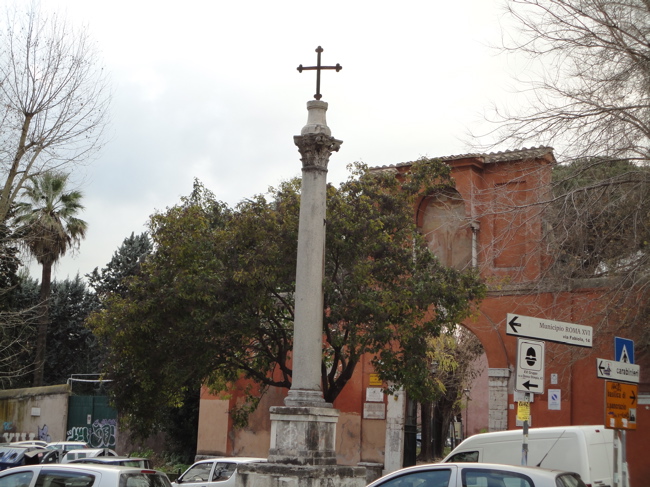
I took the number 44 bus from the Teatro di Marcello on Via dei Cerchi and crossed the river at the Ponte Palatino and up the Janiculum hill. I do not know the area that well, so at one point not being sure were I was I decided to get off near the top at the Basilica of St-Pancras on Via di San Pancrazio. This is a very old basilica and well worth a visit. Little did I know that I while standing in front of this column in the middle of the street, that it is the site of terrible battles in 1848-49 between the French army supporting the Pope against the Italian people and their leader Garibaldi, who were fighting for their independence from Papal Theocratic iron fisted rule.  A little door in the wall next to St Pancras led me into the Doria Pamphilij Garden, the former summer estate of the Princely Doria Pamphilij family. In 1960 they gave this huge estate to the Italian State, it is now a public garden.  
The formal entrance to the Doria Pamphilij Garden, the Arch of the Four Winds.

The garden is so large that a warning sign at the entrance reminds visitors not to get to far into the forested garden because when closing time comes the gates are locked and impossible to scale, meaning that you will be locked in for the night. This garden is not like the Villa Borghese, though both families are ancient and just as wealthy with their load of Popes and Cardinals among them. Innocent X was a Doria Pamphilij Pope and Paul V a Borghese Pope.

The Doria Pamphilij garden is known for its wonderful views of Rome and the surrounding countryside. There are no ruins, no statues, the original Palace was totally destroyed by the French cannon fire in 1849, it was replaced today by a Gate of the Four Winds. The estate witnessed a terrible massacre of Italian fighters at the hands of the Papal and French Army. Garibaldi lost the battle and managed to escape and the Pope ruled Rome for another 21 years through fierce exactions against the population and with the help of the Vatican Secret Police. As I left the garden I walked down past the ruins of the Vascello on Via Garibaldi and came to the Arch celebrating the Papal victory. The Inscription on top says in part that the impious enemies of Christ (aka the Romans and Italians) were defeated.  On a side street is the entrance to the Villa Aurelia also badly damaged by French cannon fire and today the seat of the American Academy in Rome.
Pope's Triumphal Arch over the Italian people

Via Garibaldi, on the left is Villa Aurelia and in front a glimpse of the panorama of Rome.

Continuing down the road already a spectacular view of Rome is visible and there on the right hand side of the road is the Fontanone or big fountain it is the terminal point of the Aqueduct of Emperor Trajan and was restored by Pope Paul V to give water to the people of Trastevere.

The Fontanone, Aqua Paola

The four granite columns of the fountain are from the original front entrance pillars to the original basilica of St-Peter built in the fourth century and demolished in 1450 to make way for the new basilica of St-Peter we know today. The water is spring water and very good to drink. Across the road from it is the Royal Spanish Academy and the Church of St-Peter in Montorio first built by the Benedictines and paid for in part by Saint-Louis King of France and then later on re-built and paid for in whole by Ferdinand and Isabella of Spain. The Church thus became the National Church of Spain in Rome.

I took quite a few pictures of Rome from this panoramic point, the sun was coming out and despite the clouds I could see clearly some 80 km from the city all the way to mount Terminillo.
View of Rome, left the Belvedere on Pincio Hill, centre the French Academy and right the steeple of Trinita dei Monti.

I then went to visit the Church and discovered a very strange story and  how it became an important point of pilgrimage. It appears that around the 10th century the story started to circulate that St-Peter had been tortured and crucified on the spot where the church stands today.  It is believed that this story first started with the poor translation and obvious mistakes of some monks who were barely able to read and write, let alone translate Latin into the local dialect spoken then in Rome.
The Tempietto of Bramante

The mistake in translation was discovered but at this point the spot was a favorite of pilgrims. Franciscans took over the site and continued with the same old canard and prospered from it. The Spanish Crown needing for political reasons a special Church in Rome with a strong association with one of the Catholic Church first star were all too please to put more financial support behind the enterprise and even commissioned in 1502 Bramante to built the Tempietto (little temple) on the spot believed erroneously to be where St-Peter was crucified.

At this point I was feeling a bit tired and the sun was setting, so I came home by walking down the hill to  Via Trastevere and took the no. 8  tram to Piazza Argentina.  A good visit in an unknown, for me, spot of Rome.

 Piazza Venezia and the Christmas tree

Sunday, 3 October 2010

another walking tour of the Roman Forum

Today I took another tour of the Roman Forum, you would think that after all the reading and walking around I have been doing in the last 16 years that I would know everything about the place, not quite. Today the walking tour was with Yannick Nexon the Director of the French library in Rome and a man of great erudite knowledge. I had taken a tour of the Farnese Palace seat of the French Embassy on Piazza Farnese. It was a fantastic tour, his knowledge is just amazing. He has a great talent for details that will catch your imagination. He is one of the many experts who work at Inventer Rome which is a group of French historians and archeologist, all specialists in their own field.

(ancient fig tree where the shepherd found Romulus and Remus)

The Roman Forum today is very different from what is was 200 years ago, as of 1805 when Napoleon I arrives in Rome, he orders massive excavations, what you see today is the street level of the age of Augustus 40BC onwards, but there are another 800 years of sub-soil prior to Augustus from the early foundation time of Rome that are yet to be excavated. For most visitors to the Forum it is a very confusing place, you need to know some Roman history, otherwise it is just a field of ruins, but what a fascinating place it is.

Today we started by the Arch of Septimus Severus, at the foot of the Clivus Capitolinus. It turns out that on the original 7 hills where basically little villages, the Sabines lived on one, the Latins on another, etc.. Really small villages of 50 to 60 people living in huts and below was a big swamp and a place of mystery and myth, separating them and this place became the Roman Forum, the central square, place of business of ancient Rome. There was no understanding in Antiquity of what a swamp was, people believed that it was the entrance to the underworld or Hell. This gave rise to a lot of the original beliefs, all tied to history and the development of the Pagan religion. There is a well by the arch, I had never noticed it before, it was said to be the Gate of Hell which you can see and this door was opened 3 days a year for worship and prayers. Today the door is gone so the Gate of Hell is simply open, a fence keeps people away just in case you wanted to walk into Hell to see what is going on, like Euridice.
There are also old trees in the Forum, one group is an Olive tree, a Fig tree and a Vine, they have been there since antiquity, seen as sacred symbols, source of life and were worshipped as such.
Another Fig tree by the Senate house is said to also be the sacred tree which gave shade to the shepherd who found Romulus and Remus being suckhold by the She-wolf. It was also the spot in ancient Rome where prostitutes of all stripes use to hang out. As we arrived at the House of the Vestal Virgins and Temple to the holy fire, Nexon explained that what we see is a construction of the period after he great fire of Rome under Nero in 64 AD. Nero wanted a city with a grid pattern, the ash from the fire found in the area was a foot deep. we know that the Vestal remained an order who maintained the fire until at least 410AD, when under the order of the Pope it was put out for ever.
(gate to the underworld and Hell)

I also learned that Anastasia the sister of Emperor Constantine in 320 AD created what we know today as Christmas, she basically instituted the holiday, inventing the Christmas story and its observance and for her efforts she is mentioned in the second mass in the Christmas Service. No one before then believed that Jesus was born on December 25 and no observance existed, there was no date as such.  In ancient Rome this was the date for a famous Pagan Festival the Saturnalia, a festival to male virility and female fecundity. Apparently also the conversion of Constantine to Christianity was not well received at all by the majority of the population who belonged to numerous other religions including the old Pagan cults of Rome. The population could not understand why they had to adopt a new religion based on Jewish beliefs.
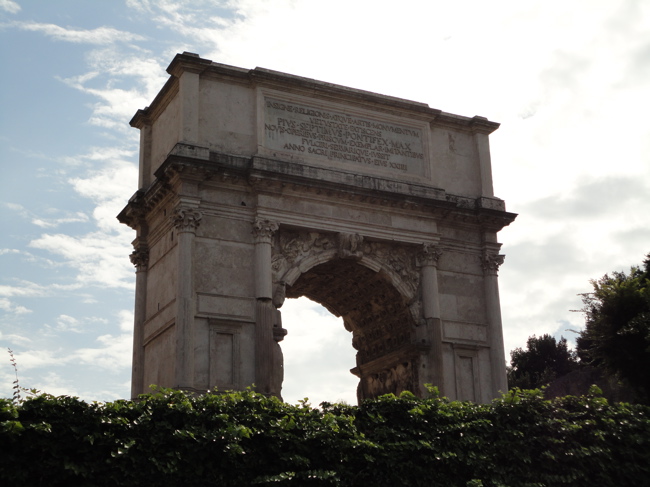
(Arch of Emperor Titus who destroyed the Temple in Jerusalem)

Until 520 AD many pagan temples still functioned and worship of the old gods continued, until the Pope became so exasperated that he started to institute persecution of non-Christians and the destruction and closing of Pagan temples. Now that was a twist I did not expect, the Roman Catholic Church in Rome loves to paint itself as a victim, now it turns out that they were the persecutors, apparently much evidence of aggressive Church policies have emerged in the last 20 years with new discoveries in the Forum.

What we see today of the Forum is mostly a field of ruins, this was caused primarily by a series of earthquake in Rome in the ninth century and in the 14th century and as of 1500 the Popes started using the Forum area as a vast quarry for their own Church building projects robbing the world of priceless art work, our Western Cultural legacy. This was done in response to the Reformation in much of Europe which scared the Popes and shook the Church. A period of great intolerance and violent repression under several Popes. The barbarian invasions did some damage but none lasting and what was damaged was often rebuilt afterwards.

The swamp was eventually drained by the Romans with the building of the Cloaca maxima, (purifying drain) which took the water to drain into the nearby Tiber river. Many buildings in the Forum are now newly opened to visitors, such as the House of Augustus on the Palatine, the temple of Jupiter Stator also known as the church of St-Romolo, one can walk to the grain storage houses which are also a support platform 7 storey high supporting what was the Palace of Caligula and connecting it to the Capitoline hill and the Temple of Jupiter great and best.

By walking around the Forum, Nexon also explained how today's Roman Catholic Church incorporated as much as possible of the old Pagan religion into Christian beliefs, per example Castor and Pollux the twins of the underworld are replaced by St-Damian and St-Cosmo, who never existed in reality and were not twins either. This incorporation was necessary if Christianity was to be accepted by the majority of people.

The event of Christmas day in 730 AD when Charlemagne comes to Rome to formally recognize the Pope as a religious authority and be his right hand man in imposing one religion is Europe is significant because it coincides with the development of a new religion in the Holyland, Islam and in Europe the old Pagan religions were still alive and thriving. With all this competition Christianity had a difficult time to impose itself.

(Temple of the Divine Emperor Antonin Pius and his wife Faustina)

This visit gave me a fresh look on Rome and how the city was shaped and built. It also gave me a new look on religion and how in ancient Rome political development, daily life, myth and superstition played an important role in the lives of people. This visit was certainly not the approved version of the Vatican.

Sunday, 15 August 2010

Legacy of Augustus

Today we celebrate in Italy a holiday which had its origin in the time of Augustus, first Emperor of Rome, a fertility feast which was part of the political program of Augustus to augment the population of Rome. Christians then took this most popular feast and gave it a make over, fertility turns to Virgin Mary, who is the Christian Venus or Minerva or both.

Ferie (Feast) of August, FerrAgosto, the Feast of the Virgin Mary ascending into Heaven upon her death. In Napoleonic times, the 15 August was Saint Napoleon I.
The French invaded Italy in the pursuit of Revolutionary ideals to abolish the superstitions of the Roman Catholic Church and most religious holidays were modified to fit a more modern agenda, as the saying went, War conquers Peace. In keeping with the general idea of the prestige of France, Napoleon wanted to do away with the influence of the Pope over life in Catholic Europe, Napoleon had Pope Pius VII arrested and carted off to Paris, to live under house arrest. He was a modernizer, his era was one of confrontation of the old order of the Princes in all Europe against that of the will of the people under the direction of one man.

Napoleon was all too aware of his humble origins, so he married his sister Pauline into the Borghese family, who is remembered for her naked pose immortalized in marble reclining as a Roman empress. The Borghese an ancient and powerful family, with at the time one of the most prestigious art collection in Europe, was for the Bonaparte family a prize catch.
His son l’Aiglon was created at birth King of Rome and the Bonaparte family palace is on Piazza Venezia in Rome between the Palace of Prince Doria Pamphilij and Prince Colona, good company all around.
Upon Napoleon’s exile to Elba and then St-Helen, the popes were quick to do away with all modern things and bring back the holiday to the original idea, but the deed was done and Italians had other ideas and despite the Popes repression and persecution of the general population, the holiday had taken on a different meaning. By 1860 unified Italy turned the holiday progressively to one of vacation and leisure for the whole family. August becoming a month of vacation, everything is closed and everyone goes to the beach, the countryside, the mountains, even if you live in the countryside you go on vacation somewhere with the family. No one in business would think of being open during FerrAgosto. Thus we find ourselves in Pesaro on the beach. Though this year because of the financial crisis in Italy, the beach is quiet, restaurants are not so busy, but the sun is shining and we are enjoying a large glass of Proseco.
Buon FerrAgosto a Tutti!