Showing posts with label Marie-Antoinette. Show all posts

Tuesday, 30 October 2012

The Wallace Collection at Hertford House, Manchester Sq. London

I always wondered what was in that great house on Manchester sq behind Selfridges in London. The house has a long history connected to several noblemen. It is said to be the finest collection of art ever assembled by one family, five generations, four Marquesses of Hertford and Sir Richard Wallace. Part of this collection is the most complete French Royal artifacts, furniture, objects, paintings of the period 1700 to 1790, all from the massive sales the French revolutionaries conducted as of 1793 from the Palace of Versailles and le Petit Trianon, including Sèvres porcelain dinner service and silverware, beautiful paintings and other small objects.  It also contains Medieval and Renaissance works of Art, Flemish Art, Dutch Art, Dutch masters, French Art, British Portraits, set in beautiful rooms as it might have been when Sir Richard Wallace lived there. The staff are very helpful, they can show you a work of art you would like to see but cannot find because of the size of the house. It is difficult to imagine living in such a house today loaded with art treasures and fine furniture. Then again people had lots of servants to take care of everything for you. Life was as a different pace and collecting beautiful things to impress society was important, it gave you gravitas. Much time was spent visiting fine houses and admiring the objects d'arts. Today the Wallace collection is the mirror of an age long ago. But it is not the only house in London where you can see how people lived. Some of these people like Frederick Lord Leighton who also has a beautiful house in the Arts and Crafts style at 12 Holland Park Road in Kensington, now a museum and an imposing mausoleum in St-Paul's Cathedral.

Hertford House known as the Wallace Collection on Manchester Sq, W1, London

one of the many rooms of the house, to help the visitor they have photos of the rooms as they were in 1890 when Sir Richard Wallace lived in the house. Not much as changed.

One of the many paintings on Napoleonic wars. This one is entitled the Regimental dog. The little dog has been injured and the drummer boy is cleaning the wound.


The top of the stairs in the house.

the Marie-Antoinette salon, everything in this room belonged to the Queen.


The middle painting is by Marie-Antoinette's personal portrait painter Marie-Louise Elizabeth Viger- Lebrun. The National Gallery in Ottawa will be holding the first retrospective of her work in 2014.
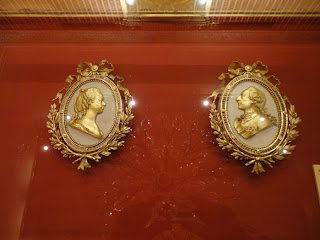
 Two medallions of Marie-Antoinette and her husband Louis XVI, made in 1774 of gilt bronze on marble.
this painting of Francesca da Rimini and her lover in hell visited by the poet Dante in his book
the Inferno. The frame was made following the text of Dante's epic work for Anatole Demidoff Prince of San Donato in 1853.

The original bill of sales of 1793 from Versailles advertising all the Royal property put up for auction by the Convention. Marie-Antoinette had 2 months to live at that point, her husband Louis had already been executed.


Saturday, 29 September 2012

Conference at the National Gallery of Canada

I was invited to attend a conference today in the auditorium of the National Gallery of Canada organized by the Director of the NGC and the French Embassy. The theme of this conference was entitled ''Visions: Art Museums in the 21 Century'' a discussion on the transformation and challenges facing museums today and the role of directors.

Invited guests where Xavier Dectot, Director of the new Louvre-Lens (pronounce Lance) in the small city of Lens (pop 36,000) in the Nord du Pas de Calais, which is near the Belgian border, an old coal mining area.
This new museum will open on 4 December 2012 designed by a team of Japanese architects, it is enormous and sits on 22 hectares of land formerly known as Pit no.9. It is an all glass building, each single pane of glass measures an impressive 6.80 meters or 22 feet in length.
The other guest speaker was Laurent Salomé, Chief Curator at the Réunion des Musées Nationaux, Grand Palais in Paris. who spoke on what they were doing to bring more people to the museums.

Paul Lang, Chief Curator of the NGC was hosting and Marc Mayer, Director of the NGC was present as was the French Ambassador and his spouse. There was probably about 150 museum members present. The conference was in French with English simultaneous translation.

It was interesting to hear both guests who painted a difficult picture of the realities of Art Museums today, the average French Citizens goes only once per year to any museum. Only 50% of the population of France actually goes to visit a museum. Most people who visit museums are women over 50, usually retired with some money and a University diploma. The challenge for the director in attracting visitors to the New Louvre-Lens is as follows; the new museum is situated in an economically depressed area, the coal mines all shut down in the 1970's, largely a young population, poorly educated with high levels of unemployment. Lens in its description reminded me of those mining company towns in novels like Germinal by Emile Zola. The construction of the new Louvre-Lens follows the democratization and decentralization of museums, a movement which is popular in Canada and now being copied in France. So what will be on show at the Louvre-Lens will be borrowed for 5 years from le Grand Louvre in Paris. It will also feature temporary exhibits and contemporary artworks.

Canada and France have numerous collaborative efforts in the organizations of exhibitions and studies. This brings about a sharing of exhibits touring cities around the world, to save money and to generate revenues for each museum. Our guests bemoaned the fact that in France the budgets for Culture have been slashed severely. We were told that we should be thankful our Canadian Government which reduced the budgets of all National Museums has not been more drastic in comparison.

Reliance on private donors and private funding for exhibits is now the game and multinational companies are being courted assiduously, they are taking up where national governments have left off. In the last 15 years major exhibits have been funded almost 100% by private enterprise in Canada but also now in France and probably elsewhere in the world. Though our French guests admitted that there was still a big debate in France between generations of Curators on the merit of having private companies finance Art exhibits, many see that as cheapening the process.


Attendance is also down in Museums and I can vouch for that, I can see it at the NGC in Ottawa but also at the other National Museums like Civilizations and the National War Museum how very few people visit everyday.  Xavier Dectot was saying that if you took out only 3 famous art work at the Louvre, people would probably stay away, he mentioned the Venus of Milo, the Mona Lisa and the Victory of Samothrace. Entire galleries like the one devoted to the 17th century painter Nicolas Poussin are deserted. We saw that in Italy where people went to a museum to see one art work and ignore the rest, comes to mind the David by Michelangelo in Firenze.

The French are promoting now something we have been doing in Canadian Museums for a long time which is to make use of technology to promote museums, sending docents out to schools to promote art works and interest in the arts in general. Offer school teachers free programs to help them with their class curriculum. I was pleased to hear our guests compliment Canada and the NGC for our modern approach in trying to attract the public back to our museums.

I was relieved to see that our problems in Canada are the same elsewhere, a factor of a changing world and interest and falling educational standard. They are not insurmountable but a major challenge for any  museum director.

I also learned that a major retrospective of the work of Marie-Elizabeth Vigée-Lebrun will be held at the NGC in 2014. She is said to be the most important female painter of the 18th century in France. She was the official painter of Marie-Antoinette. She also worked in Italy, Russia at the Court of Catherine II, in Switzerland and in England. There has never been a retrospective of her work.

Marie Elizabeth Vigée-Lebrun (1755-1842)


Monday, 30 April 2012

La Reine

Joseph Haydn composed a series of symphonies called Paris Symphonies and this one no. 85 was dubbed La Reine because it was a favourite of the unfortunate Marie-Antoinette, married at 14 to Louis XVI and died at the young age of 38, leaving behind 2 children. Only her daughter will survive the revolution living in exile with other Bourbon Family members.


Played here by the Orchestra of Saint-Martin in the field under the baton of Sir Neville Marriner.