Monday, 19 April 2010

Sunday


This week all museums in Rome are free. It also coincides with the anniversary of the Eternal City, the theme this year is ''Rome Emotions without end''. So I went to one of my favorite museums in Rome on Sunday, the Massimo on Piazza Cinquecento (500) in front of the Termini Central Train Station.

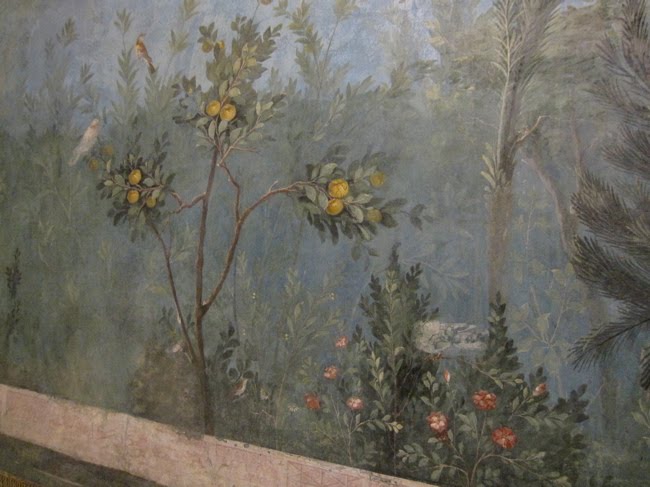
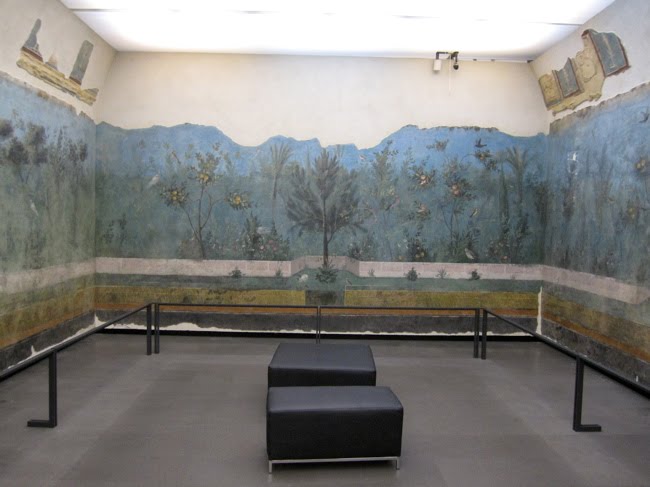
The Massimo is one of those must see museums in Rome. It concentrates on the Julio-Claudian Dynasty who basically launched imperial Rome. It has per example the dining room of Empress Livia, wife of Augustus from her country Villa at Prima Porta with its exquisite painted walls of a sumptuous garden with trees, flowers, fruits and birds. The colours alone are vibrant and shows the high quality of the art work, you have to imagine what it must have been like when the paint was still fresh with its glossy finish. There was also a special exhibit of antique gold and silver dinner ware from Morgantina in Sicily. Again very fine art work, elegant and refined from the house of a rich merchant. Morgantina was totally destroyed on the orders of Augustus in 35 BC because the city sided with Carthage against Rome. There was also a second special exhibit of funerary dinner ware used during a funeral wake. The various pieces were decorative painted marble to decorate the area of the Mausoleum used by the family for their banquet in honor of the deceased.

Then after this visit, I decided to walk around and ended up at the Barberini Palace, once the seat of the famous Florentine Family which gave us Pope Urban VIII.
Maffeo Barberini, was pope from 1623 to 1644. He was the last pope to expand the papal territory by force of arms, and was a prominent patron of the arts and reformer of Church missions. However, the massive debts incurred during his papacy greatly weakened his successors, who were unable to maintain the papacy's longstanding political and military influence in Europe. He was also involved in a controversy with Galileo and his theory on heliocentrism during his reign.

The Palace is enormous and contains mostly religious works of art by great artists of the Renaissance, of note the famous painting of King Henry VIII by Holbein. The Barberini Pope is famous because he pillaged the Pantheon, removing all the bronze in the temple to make cannons and to also built the great Baldaquino above the main Altar in St-Peter's Basilica. The Romans of the time said, What the Barbarians did not destroy, the Barberini did. The coat of Arms of the Barberini is 3 bees, though the story goes that they use to be horse flies until Maffeo became Pope and changed it to the more noble bees.

Then I came home to discover that our visitors who were to come from Canada could not come because of the Volcanic ash and that Rome airport was partially closed. In fact the Pope was in Malta for the weekend and it was not all together sure he could fly back to Rome on Sunday night. Well this only meant more Veal Saltinboca for dinner and strawberries for dessert.

Thursday, 15 April 2010

More of Palermo


I thought I would show a few more pictures of Palermo, of the people, the food, the streets, so picturesque and on a human size. Buildings are 5 to 6 floors high no more, pedestrians have the right of way and everything is within walking distance so no need for a car. People know their neighbours. Restaurants and shops are family owned. The big box stores are all on main street and nowhere else, no shopping malls, you shop where you live. Fresh produce markets are located in all neighbourhoods and you can get everything you need.
This is not to say that Palermo is without social problems, there is poverty and the Mafia still has a hold on business but that hold has been shaken and is not as before, young people have a different approach and think differently. Sicily is well worth a visit and a beautiful one it will be.
All photos here have been taken in Palermo, be its ancient church steeple or the market at Porta Cardini or marathoners in front of the Opera house Teatro Massimo.

Monday, 12 April 2010

Palermo, Sicily


I took a week of vacation and went south to Sicily. I learned quite a few things, for one Sicily only became part of Italy in 1860 or 150 years ago. To this day people in Sicily have their own language and speak of Italy as the other country next door. Sicily originally was part of greater Greece and populated by Greeks, legend says that many came after the fall of the City of Troy. Then other groups arrived, the North Africans from Carthage (Tunis), the Romans, the Arabs and then the Normand's with King Roger and his son William the Conqueror who invaded England in 1066. The Germans with Emperor Frederick II of Hohenstaufen (1194 –1250) shaped the politics of Europe in his time, the French with Charles of Anjou and then the Spanish Bourbon, Lord Nelson had an Estate in Sicily, finally the Italians arrived with Garibaldi in 1860 to liberate the Island, the population did not have much of a choice. All this makes for a colorful history and wonderful culture.

Sicily being a volcanic island like Hawaii, has incredibly rich soil and produces a great variety of vegetables and fruits. It also has many exotic flora and fauna, not exactly the distorted picture Hollywood loves to present of a dirt poor desert like wind swept island, think of the Godfather movie trilogy.
The people are very nice and hospitable, the cuisine is imaginative and delicious, lots of fresh fish and seafood, they have a deep red tuna found just off the coast of Sicily which is wonderful. Palermo has the second largest Opera house, Teatro Massimo, after Paris built between 1875-97, with its mahogany panelling and hand painted water silk ceiling. It was closed for 25 years for repairs and re-opened in 1997. It still needs a lot of maintenance.
With so many great rulers having made of the island their centre of power, there are lots of monuments, churches and palaces. The Franciscans, the Dominicans and Benedictines all had great monasteries. The 3 greatest cathedrals of the middle-ages where built in Sicily, the first one in Cefalu by King Roger II in 1150, the second by his son William the Conqueror in Monreale in 1184 and the famous jewel like Capella Palatina (1130) in the Royal Normand Palace in Palermo, all in the Byzantine style. They chose this style of architecture to indicate that culturally and politically they followed Constantinople-Byzantium and not the Pope in Rome with whom they were in conflict. The mosaics are marvelous considering that the 3 buildings are 1000 year old, all kept in pristine conditions. Both the Cathedral in Cefalu and in Monreale where the great Normand rulers are buried in imposing red porphyry mausoleums are in use to this day. How these great buildings came to be built and where did the funds come from is a mystery to this day. The Cathedral of Monreale has 2 tons of solid gold in the mosaic covering the ceiling and walls.
A friend of mine had arranged for a special visit of 3 oratories in Palermo decorated by Giacomo Serpotta who in the 18th century developed a style of decoration which became associated with Sicily and all made of stucco, which is a composite of marble dust and other ingredients which turns into a paste and can be modeled like clay. His statues and putti are a meeting of the secular and the profane. I had a professor of art history who explained the history and style and how various artists were asked to contribute, Caravaggio was one but also painters of the Flemish school like Van Dyck came to Sicily to work.
Suddenly an Island best known today for the Godfather movies and the mafia appears under a totally different light, rich in European history, an important military post in the Mediterranean and producing great art and food, a centre for humanity.
I really fell in love with Sicily, a wonderful place, well worth a visit and so much on offer.

Sunday, 4 April 2010

Easter photos


Our friend Jack is visiting us from Beijing and he has one of those big cameras that take really professional pictures, it's a Nikon D300. He took some pictures of Nicky and Nora, the best pictures so far in their young lives, they are only 14 months old. The eyes say it all.
Our little Easter bunny killers. One has to remember that they are hounds, their parents are hunting dogs. Right now they want to kill every cat in the neighborhood, pigeons, anything basically which they think it good for hunting, nothing personal, that is what wire hair dachshunds do. Nora's mom at 5 kg, can hunt in a pack wild boars who weigh 60 kg.
We took them to the Via Appia Antica to walk on the historical road just outside the San Sebastiano gate for about 5 km. They walked it all right but when we came home, they were pooped tired and slept like logs.

Saturday, 3 April 2010

power and corruption

It is the first time in my life that I see an embattled Pontif who is more and more isolated in his Apostolic Palace in Rome. Everyday fresh revelations of this horrible pedophile scandal become public. It is very disturbing to see how the protection of status and property and the reliance on antiquated notions from the Middle-Ages appear to guide those very few people around the Pope and the Bishop of Rome himself. I was at the Teatro del'Opera the other night, the opera Tosca was featured, the plot line is easy, a love story between an artist painter who believes in a free Rome and an Italy free of Papal domination and a singer Tosca who are pitted against the Secret Police of the Pope who is desperately trying to hold on to power by arresting and executing anyone who is promoting the Roman Republic. The story is staged around 1810 at the time of Napoleon's march and liberation of Italy. Scarpia is the all powerful Police Chief and is lusting after Tosca, in the final scene of the first act while a Te Deum is being sung in the church of San Andrea della Valle in Rome, Scarpia sings, while surrounded by all the symbols of the Church's power, of his lust and how he will use his powerful office to get Tosca into his bed. In the context of today's news I could not help think how the Opera Tosca is a mirror reflection of absolute corruption. Being in Rome to see this unravel is unsettling especially during Easter week.

Wednesday, 31 March 2010

Conservative


I sort of followed from a distance the whole debate on Health Care in the USA, I am impressed with your President, he is one hell of a good President, I know many people do not like him but I like him a lot. I was impressed with him from the start and with his wife too. Just the way he handles himself and the way he approaches people, you know he is the Head of State but you also sense you can speak with him like a normal person, he will understand what you are saying. From a Foreign Affairs point of view, he is really saving your bacon USA. His demeanour and the way he approaches other Heads of State, small gestures like per example how he greeted Arab Princes with a few words in Arabic pronounced correctly, that goes a very long way. I say wow!
This is why when I hear all the so called conservatives in the Republican camp and the Tea party people with their rantings about socialism and communism and Nazism, etc... They sound so ignorant, they are also what ugly Americans look like, intolerant, arrogant and pushy.
Obama is the personification at least for me of the old fashion American, I use to know, soft spoken, friendly, kind, welcoming and not over-bearing. The passage of this bill on Health Care will no doubt do a lot of good to a lot of people in the USA. The common good that is what democracy is all about, always searching for something that brings the Nation and its people together. To think that some Americans because they have money would deny other less fortunate Americans access to health care, is the opposite of what American values, the ones of the founding fathers stood for, is all about. In any country social cohesion is based on sharing the wealth with all citizens, its equality for all, money should never be the defining element, such a society based on wealth and property and rank is not democratic. The Founding Fathers and the Americans who followed them said a loud NO to this type of Society. It would appear a lot of people have forgotten that today.

This brings me to ask what a real Conservative is, it is a word you hear a lot these days, it seems that conservative stands for me first and the hell with the rest, or only white Christians here and the rest of you are not included. The word has been bastardized by the Republicans and a few loud mouths who blab and blab without thinking.

To me a conservative is a person who adheres to moderate views and prefers tradition and stability in society, preserving established institutions, prefers gradual change. It is not what you see nowadays in the Republican party or in the right or far right. They may say they are conservative but I see more a form of extremism, which could very well lead to social upheaval instead of stability. Advocating violence per example in a protest against Health Care reform is NOT a conservative point of view.

In a civil society, discussion and listening to the other point of view is important for the advancement of ideas and of social change. Refusing to listen or coming to a debate with the idea that I am against it and will not consider any other point of view is not being conservative, it is being close minded. How did so many Americans arrive at this point?

I also think as an observer outside of America, that the fact that Obama is black, has a lot to do with the opposition we see today. It seems to me that a lot of people cannot accept that a black man is the President or that he can lead the Nation to important changes. He will pass into history now as not only the first black President but also as one of the very few President who made an important contribution during his mandate. That rankles a lot of people in America today and it is profoundly sad for such a great Nation.

Thursday, 25 March 2010

Dinner menu


Here is the Birthday dinner menu prepared for us by my caterer:
Velouté aux Poireaux (Leek cream soup)
Entrée: Paté d'Artichaux et Emincé de "Coniglio porchettato" Oignons confits (paté of arthichokes and rabbit with glazed pearl onions)
Plat principal: Tagliata de Boeuf Duroc et Julienne de Legumes croquants (filet of beef in cognac sauce with julienne crunchy veg)
Salade Mixte Saisonnière (small green salad)
dessert Soufflé au Grand Marnier (Grand marnier individual soufflé)

We had proseco to start with hors d'oeuvres and for dinner a white frascati and red Italian merlot from the Lazio region, dessert wine and liqueur.

It was an excellent dinner, no stress and so pleasant with good friends. The caterer also had place settings made for each guest with a photo of me taken in the last 24 months in different places. It was a very elegant evening.
As for gifts I got lucky, 3 bottles of vintage Veuve Cliquot Champagne, a beautiful shirt and lead soldiers.

My caterer is a Canadian who came to Italy and started her company with her husband in Frascati which is just outside Rome
www.aroundrome.it

She is catering a dinner on an historical 1930 vintage Rome Street Car for the Canadian Club of Rome in late April, that should be a great evening crossing the city by street car while having dinner. See www.canadianclubofrome.blogspot.com